Follow Us on Google
I remember a journey where, to pass the time, I started looking for patterns in the numbers I saw around me. Some were obvious, while others required multiple attempts before the logic emerged. This is what I appreciate about number sequences; they compel us to observe transformations rather than merely perform calculations.
Number sequences hold significant importance in the history of mathematics. From Fibonacci’s work to modern research on algorithms, mathematicians have utilized patterns to understand, predict, and model phenomena. Today, we see these reasoning processes applied in computer science, economics, the sciences, and numerous technologies. Searching for the logic in a sequence trains our brains to compare, anticipate, test hypotheses, and verify their validity.
“Mathematics is the science of patterns.” — Keith Devlin
This quote perfectly encapsulates this challenge: behind several seemingly different numbers lies the same transformation. The goal is to discover it before reaching the question mark.
What This Challenge Helps Develop:
- Number sequences
- Searching for patterns
- Mental calculation
- Multiplication and addition
- Formulating a rule
- Verifying a hypothesis
- Logic and concentration
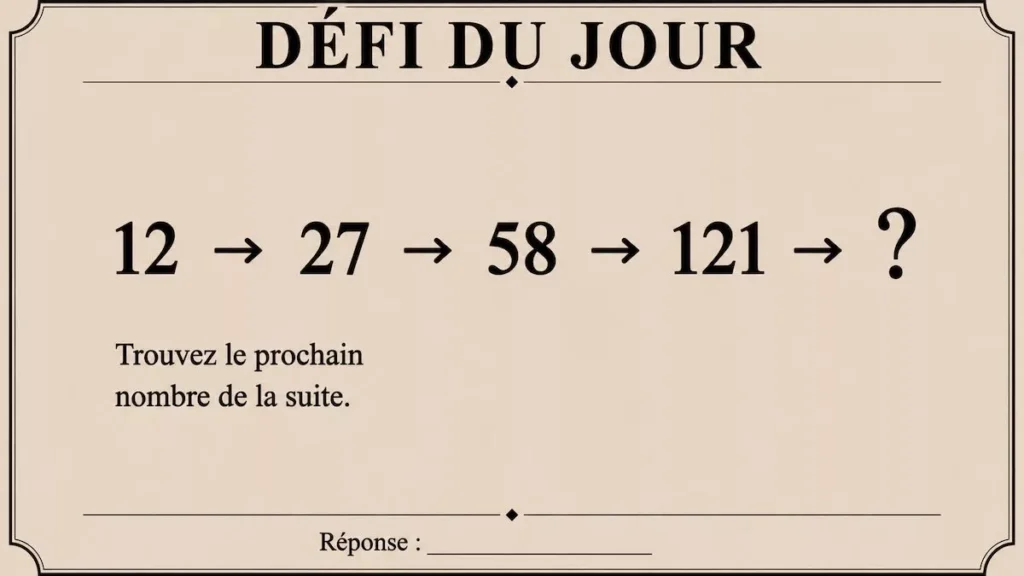
DAILY CHALLENGE
Find the next number in the sequence.
Answer: __________
Each number is derived from the previous one according to a specific rule. Will you be able to discover it before the countdown ends?
The Countdown Begins
40…
30…
20…
10…
5…
4…
3…
2…
1…
Time’s up!
What Your Performance Can Reveal
If you found the answer quickly and correctly, you have excellent logic and analytical skills.
If you found the answer after some thought, you know how to structure your reasoning and verify your steps.
And if your answer was incorrect or not found, no worries; this type of exercise is perfect for improving your method and precision.
DETAILED SOLUTION WE FOUND (NOT NECESSARILY THE ONLY OR EVEN THE CORRECT ONE)
Let’s start by observing the transition from 12 to 27.
We can express the equation as:
12 × 2 + 3 = 27
Now, let’s examine the passage from 27 to 58:
27 × 2 + 4 = 58
Next:
58 × 2 + 5 = 121
A logic is emerging.
At each step, the number is multiplied by 2, and then we add a number that increases by 1:
+3, +4, +5…
The next step should therefore use:
+6
We can write the equation as:
121 × 2 + 6 = ?
242 + 6 = 248
FINAL ANSWER
248
Verification of the Entire Sequence
12 × 2 + 3 = 27
27 × 2 + 4 = 58
58 × 2 + 5 = 121
121 × 2 + 6 = 248