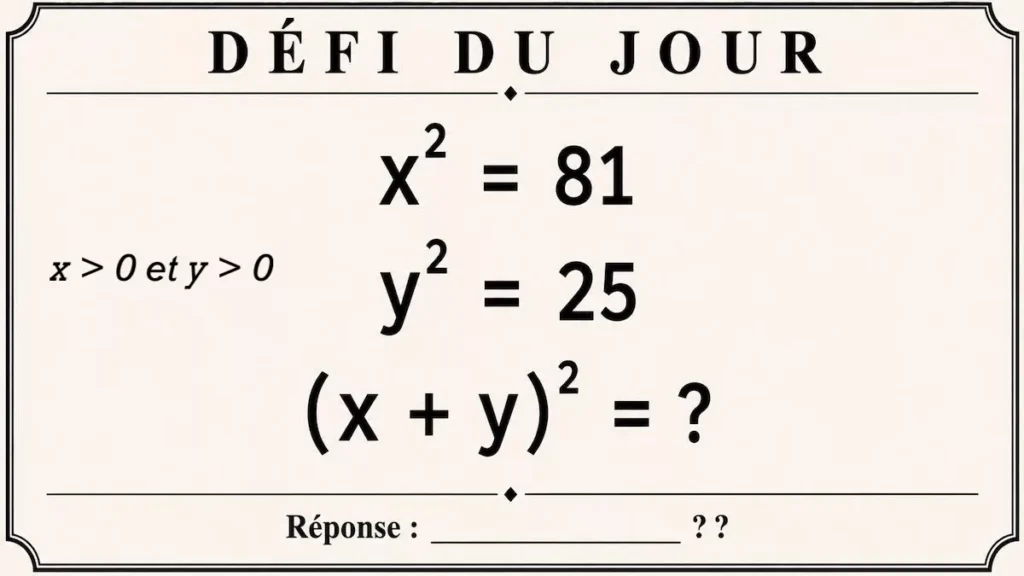
Some challenges seem almost too simple. Two perfect squares, two letters, and one last equation. Yet, it’s precisely in these types of questions that I enjoy seeing how a small detail can completely alter the answer. I remember exercises where I would quickly find the square roots… only to realize later that I still needed to consider the sign. Since then, I’ve made it a habit to never consider an equation complete until I’ve verified all its solutions.
Square roots hold a significant place in the history of mathematics. They naturally arise when working with squares, distances, and geometry. From ancient mathematicians to modern sciences, they have contributed to the development of methods used today in architecture, physics, engineering, computer science, and many scientific calculations.
“The essence of mathematics lies in its freedom.” — Georg Cantor
This idea fits particularly well with today’s challenge: an equation can sometimes open multiple paths, and one must know to examine them before choosing an answer.
What This Challenge Allows You to Work On:
- Perfect squares
- Square roots
- Equation solving
- Positive and negative solutions
- Substitution
- Squaring
- Awareness of implicit information
- Mental calculation and logic
CHALLENGE OF THE DAY
Calculate the requested value.
Answer: __________ ??
The Countdown Begins
50…
40…
30…
20…
10…
5…
4…
3…
2…
1…
Time’s up!
What Your Performance May Reveal
If you found the result quickly and correctly, you have excellent logic and good analytical skills.
If you found the result after some thought, you know how to structure your reasoning and verify your steps.
And if your result was incorrect or not found, no worries; this type of exercise is perfect for improving your methods and accuracy.
Detailed Solution We Found (Not Necessarily the Only One, or Even the Right One)
Let’s start with the first equation:
x² = 81
The numbers whose square equals 81 are 9 and −9.
So:
x = 9 or x = −9
Next, let’s move to the second equation:
y² = 25
The numbers whose square equals 25 are 5 and −5.
So:
y = 5 or y = −5
Here lies the trick of the challenge.
Since the prompt assumes that x and y are positive, we have:
x = 9
y = 5
Now we substitute into the last equation:
(x + y)² = (9 + 5)²
(x + y)² = 14²
(x + y)² = 196
Expected Answer
196
Conclusion
This challenge serves as a reminder of an essential rule: solving an equation is not just about performing a calculation, but also about verifying which solutions are actually allowed. With x > 0 and y > 0, each step leads unambiguously to 196. Without this precision, both 16 and 196 could be possible answers.
A small sign may seem insignificant on paper, but in mathematics, a single condition can determine the entire answer.
And before you get lost in the depths of the web, explore more games and tests by clicking here.