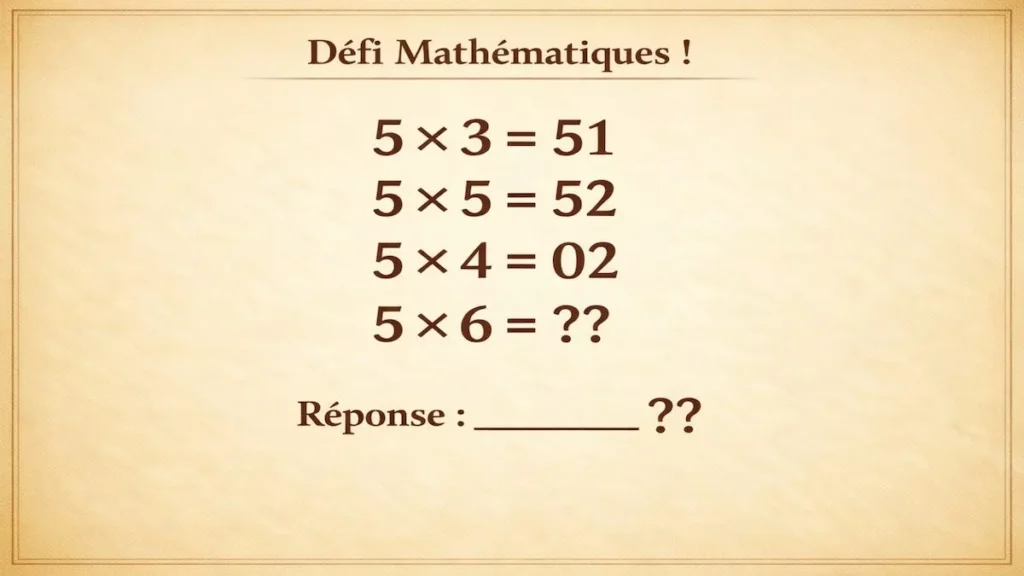
Some calculation sequences may seem simple, but they rely on strict rules of operational priority. In this type of challenge, the most common mistake is solving operations in the wrong order. It’s not just about calculating; it’s about following a logical and structured method to achieve the correct result. In mathematics, maintaining the order of operations is essential to ensure the consistency of a calculation.
As Blaise Pascal once said:
“The heart has its reasons which reason knows not.”
In France, mathematics assessments regularly show that mastering the fundamentals remains a significant challenge. These exercises provide an excellent opportunity to practice, reinforce your basics, and develop a reliable calculation method. Here, the key is not speed, but the correct application of mathematical rules.
What This Challenge Allows You to Work On:
- Respecting operational priorities
- Rigor in the sequence of calculations
- Concentration
- Step-by-step verification
- Logic of simplification
Challenge of the Day
Answer: ______ ??
Take your time to analyze each step before responding.
A priority error can easily change the entire outcome.
The countdown begins:
20…
10…
5…
3…
2…
1…
Time’s up!
So, what is your answer?
What Your Performance Reveals
If you found the result quickly and correctly, you have excellent logic and strong analytical skills.
If you found the result after some reflection, you know how to structure your reasoning and verify your steps.
If the result is incorrect or not found, no problem! This type of exercise is perfect for improving your method and precision.
Detailed Solution We Found (Not Necessarily the Only One, Sometimes Even the Correct One).
Step 1: Priorities × and ÷ from Left to Right
We handle multiplications and divisions in the order they appear:
4 × 4 = 16
16 ÷ 4 = 4
The expression becomes:
4 + 1 − 4
Step 2: Addition and Subtraction from Left to Right
4 + 1 = 5
5 − 4 = 1
Final Answer:
1
Conclusion
This equation demonstrates that a calculation that appears very simple can become tricky if operational priorities are not respected. What you need to do is follow a rigorous method and check each step before providing the final answer.