Centuries ago, long before calculators and computers, mathematics was already integral to practical activities: counting harvests, organizing exchanges, measuring land, and predicting celestial movements. Over time, it has supported increasingly ambitious achievements: architecture, navigation, mechanics, electricity, computer science, and space exploration.
However, its value extends beyond major discoveries. Mathematics also teaches us something incredibly useful in our daily lives: to observe before calculating. An equation that appears complicated can sometimes become extremely simple once we notice a crucial detail.
This reminds me of those small calculations where we start carefully multiplying the initial numbers… only to discover a zero at the end. In that moment, the entire calculation collapses in an instant! This is precisely the kind of vigilance we will test today.
Quote of the Day
“Mathematics is the door and key to the sciences.” — Roger Bacon
In other words, learning to reason with numbers isn’t just about succeeding in calculations; it fosters a structured approach to problem-solving.
What This Challenge Helps You Work On:
- Observation before calculation;
- The properties of multiplication;
- The unique role of zero;
- Mental calculation;
- Speed of reasoning;
- Attention and concentration;
- The ability to identify a crucial piece of information.
Challenge of the Day!
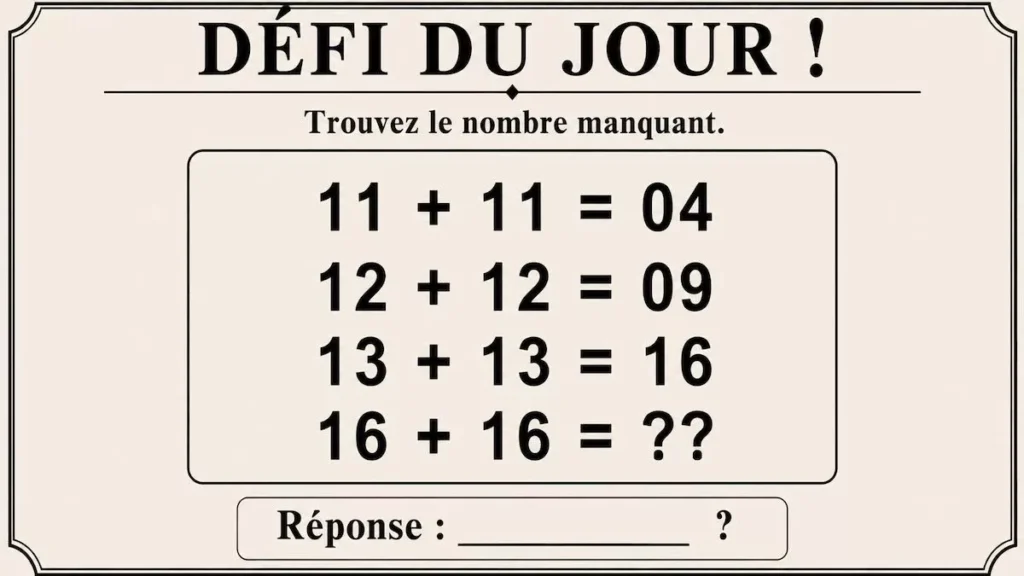
Here is the proposed equation:
Can you find the correct result before time runs out?
Caution: don’t rush into multiplication. A single number may be enough to determine the entire answer immediately.
Countdown Begins
20…
15…
10…
5…
4…
3…
2…
1…
Time’s up!
What Your Performance May Reveal
If you found the correct result quickly, you have excellent logic and good analytical skills.
If you found the result after some thought, you know how to structure your reasoning and check your steps.
If your result was incorrect or not found, no worries, this type of exercise is perfect for improving your method and accuracy.
Detailed Solution We Found (Not Necessarily the Only or Correct One)
We could start normally:
5 × 5 = 25
Then:
25 × 10 = 250
And finally:
250 × 0 = 0
But there was a much quicker method.
As soon as we see × 0, we know that the result of the entire multiplication will be 0.
Why?
Because any number multiplied by zero equals zero.
Thus, even without performing the initial multiplications, we could immediately conclude:
5 × 5 × 10 × 0 = 0
Answer: 0
Conclusion
This challenge was deliberately very simple in appearance, but it primarily tested your attention. The true objective was not to quickly multiply 5, 5, and 10 but to immediately notice the presence of zero.
This serves as an excellent illustration of an important principle in mathematics: the best solution is not always the one that involves the most calculations, but the one that effectively utilizes the properties of numbers.
If you answered 0 almost instantly, congratulations: you didn’t just calculate; you primarily observed before acting.
And before you get lost in the depths of the web, explore other games and tests by clicking here.