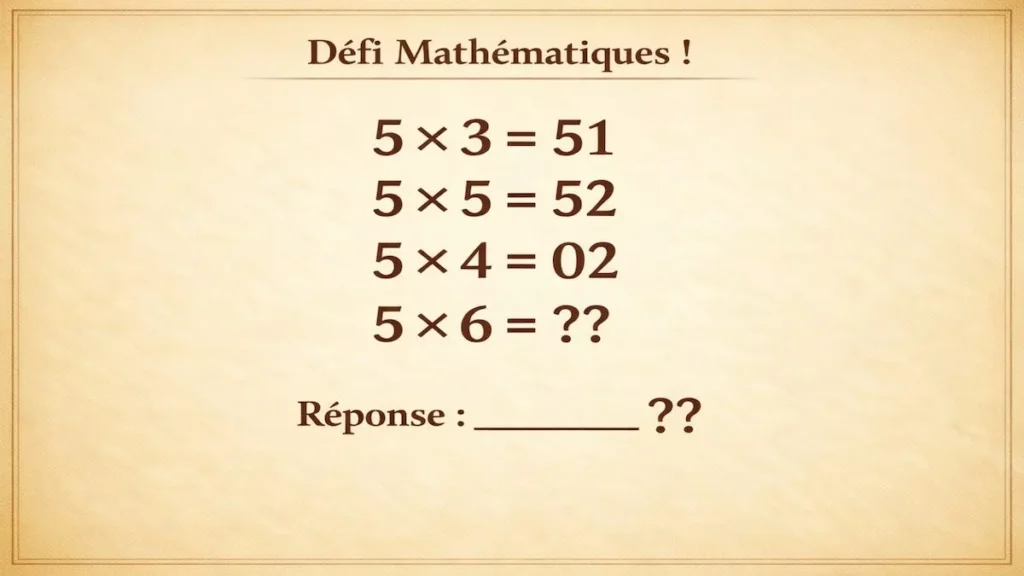
Some sequences of operations may seem quite strange, as they do not adhere to the conventional rules of calculation. In this type of exercise, the main challenge lies in identifying the hidden logic before applying a solution method. It is not just a simple calculation, but rather a task of observation and deduction.
In France, mathematics assessments consistently show that success depends as much on the method as on the final result.
Such challenges are therefore useful for developing logic, concentration, and the ability to discover a repetitive structure within a series of equations.
As Carl Friedrich Gauss once said:
“It is not knowledge, but the act of learning; not possession, but the act of achieving, that brings the greatest pleasure.”
This reminds us that every sequence or equation is based on a specific rule that must be discovered with rigor.
What This Challenge Helps Develop:
- Identifying the rule in a sequence of equations
- The logic of constructing a mathematical pattern
- Rigor in step-by-step analysis
- The ability to deduce
- Verifying the consistency of results
The Challenge of the Day
Answer: ______ ??
Take the time to carefully observe the relationships between the numbers before responding.
A hasty reading can easily lead to misinterpretation.
The countdown begins:
30…
20…
10…
5…
3…
2…
1…
Time’s up!
So, what is your answer?
What Your Performance Reveals
If you found the result quickly and correctly, you have excellent logic and good analytical skills.
If you found the result after some reflection, you know how to structure your reasoning and verify your steps.
And if your answer was incorrect or not found, no problem; this type of exercise is perfect for improving method and precision.
Detailed Solution We Found (Not Necessarily the Only One, or Even the Right One)
What we have here is not a classic multiplication, but a transformation of the result.
Step 1: Observe the Structure
First, we calculate the normal products:
- 5 × 3 = 15 → becomes 51
- 5 × 5 = 25 → becomes 52
- 5 × 4 = 20 → becomes 02
We notice that the digits of the result are not left as they are; they are reorganized.
Step 2: Identify the Rule
We observe that:
- We take the product
- Then we apply a transformation where the order and value of the digits are modified in a nonlinear way
- The result follows a logic of “coding” around the number 5
Testing for consistency:
- 15 → 51 (inversion)
- 25 → 52 (partial inversion with adjustment)
- 20 → 02 (inversion with format conservation)
Step 3: Apply to 5 × 6
- 5 × 6 = 30
- Transformation of the same type → inversion + coding
So:
- 30 → 03
Final Answer:
03
Conclusion
The rule becomes clear when we compare each step: we do not perform a fixed operation, but rather a progressive correction that changes with each line.
And before you get lost in the depths of the web, explore other games and tests by clicking here.