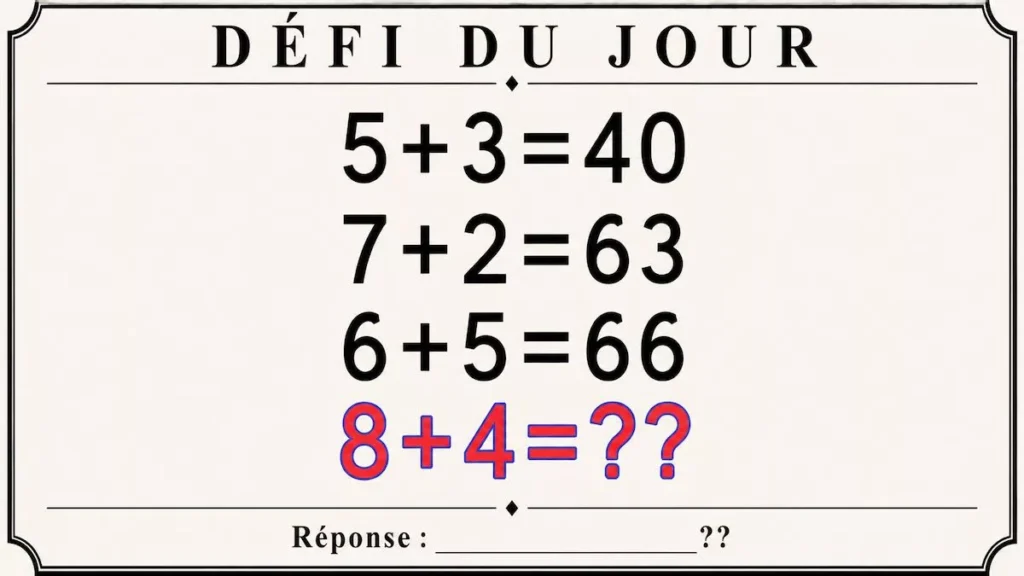
I remember a number game where I initially tried all sorts of complicated operations. The more I calculated, the further I strayed from the solution. Then I noticed that a very simple rule worked for each line. This is something that mathematics has taught me over time: before seeking complexity, one must observe what repeats.
Since the dawn of civilization, humans have sought patterns in numbers. These explorations gradually gave rise to arithmetic, algebra, and numerous calculation methods.
Today, the ability to recognize patterns is essential in computing, algorithms, science, and data analysis. Thus, these little challenges serve not only to calculate but also train our brains to observe, formulate a hypothesis, and above all, verify it.
“Mathematics is the music of reason.” — James Joseph Sylvester
This quote fits well with this challenge: like in a melody, one must find the rhythm that repeats behind the numbers.
What This Challenge Helps Develop:
- observation
- searching for a hidden rule
- multiplication
- addition
- mental calculation
- hypothesis verification
- logical reasoning
- concentration
Challenge of the Day
Find the hidden rule and calculate the last value.
Answer: __________ ?
Note: the symbol + does not correspond to a standard addition here. You must discover the rule used to obtain the results.
The Countdown Begins
40…
30…
20…
10…
5…
4…
3…
2…
1…
Time’s up!
What Your Performance Can Reveal
If you found the answer quickly and correctly, you have excellent logic and good analytical skills.
If you found the answer after some thought, you are skilled at structuring your reasoning and checking your steps.
If your answer is incorrect or you didn’t find it, don’t worry; this type of exercise is perfect for improving your method and accuracy.
Detailed Solution We Found (Not Necessarily the Only One)
Let’s observe the first line:
5 + 3 = 40
To obtain 40, we can add the two numbers and then multiply the result by the first number.
Let’s set up the equation:
5 × (5 + 3) = 40
Calculating:
5 × 8 = 40
Now let’s verify this rule with the second line:
7 × (7 + 2) = 63
7 × 9 = 63
The rule works.
Now let’s check with the third line:
6 × (6 + 5) = 66
6 × 11 = 66
Thus, we can apply the same rule to the last line:
8 × (8 + 4) = ?
Starting with the parentheses:
8 + 4 = 12
Then:
8 × 12 = 96
Final Answer
8 + 4 = 96
Verification of the Rule
5 × (5 + 3) = 40
7 × (7 + 2) = 63
6 × (6 + 5) = 66
8 × (8 + 4) = 96
Thus, the same rule applies to all four lines.
Conclusion
This challenge illustrates an important difference between calculating and reasoning. A standard addition would obviously yield 12, but that is not what the riddle asks for. It required discovering a rule that could explain 40, 63, and 66 before applying it to the last line.
Using the same logic, we arrive at 96. This is the essence of such challenges: training our brains to observe a pattern, construct a hypothesis, and test it before providing an answer.
And before getting lost in the depths of the web, explore more games and tests by clicking here.