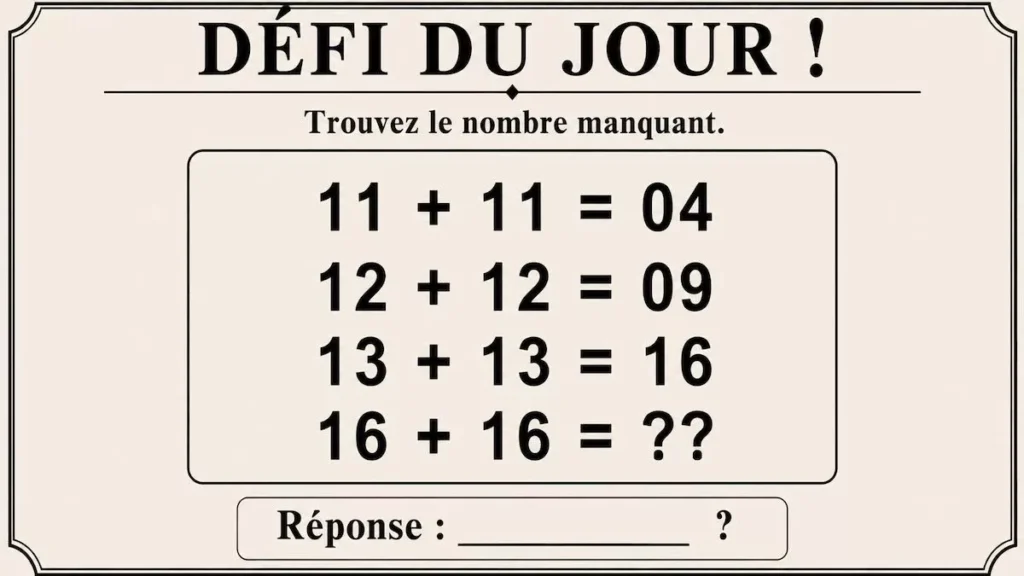
Mathematics is not just about calculations: it is also the art of uncovering hidden rules. From the earliest civilizations observing celestial cycles to modern scientists designing algorithms, humans have continuously sought patterns in numbers. This ability to recognize patterns has led to extraordinary achievements, such as predicting astronomical phenomena, advancing computing, securing communications, and analyzing vast amounts of data. Behind many of these advancements lies the same question: what rule lies behind the information we observe?
I remember challenges where I was searching for a very complicated operation, only to realize that the solution was almost right in front of me. I eventually understood that before calculating, it is often necessary to compare lines and observe what changes. Today’s challenge is exactly of that nature.
Quote of the Day
“Mathematics is the science of patterns.” — Keith Devlin
This quote fits our challenge particularly well. In mathematics, recognizing a structure or a pattern can sometimes allow for solving a problem much more rapidly than by attempting random calculations.
What This Challenge Allows You to Work On:
This challenge allows you to work on:
- Observation of numbers;
- Searching for a hidden rule;
- Recognizing a logical sequence;
- Mental calculation;
- The ability to formulate and then verify a hypothesis;
- Concentration;
- Logic and quick reasoning.
Challenge of the Day
Pay close attention to these equations:
So:
16 + 16 = ?
Be careful, this is obviously not about ordinary additions.
Your mission is to discover the rule used in the first three equations and then apply it to the last one.
The Countdown Begins
60…
50…
40…
30…
25…
20…
15…
10…
5…
4…
3…
2…
1…
Time’s up!
What Your Performance Can Reveal
If you found the result quickly and correctly, you have excellent logic and analytical skills.
If you found the result after some reflection, you know how to structure your reasoning and verify your steps.
And if the result was incorrect or not found, no worries; this type of exercise is perfect for improving methodology and precision.
Detailed Solution We Found (Not Necessarily the Only One, Sometimes Even the Right One)
Let’s observe the results: 04, 09, 16
These numbers should immediately catch our attention:
04 = 2²
09 = 3²
16 = 4²
But why do we obtain 2, 3, and 4?
Let’s look at the initial numbers:
For 11, we add its digits: 1 + 1 = 2
Then we square the result:
2² = 4, written as 04 on the board.
For 12: 1 + 2 = 3
Then: 3² = 9, written as 09.
For 13: 1 + 3 = 4
Then: 4² = 16
The rule is therefore: add the digits of the number, then square the result.
Now, let’s apply this rule to 16:
1 + 6 = 7
Then:
7² = 49
We can therefore write:
16 + 16 = 49
according to the specific rule of this challenge.
Final Answer
49
Conclusion
This challenge illustrates why one should not always interpret the symbol “+” as traditional addition when faced with a logic puzzle. Here, the initial equations intentionally define a specific rule that needs to be discovered. The key was to observe that 04, 09, and 16 are perfect squares. Once this regularity was identified, the mechanism becomes clear: we add the two digits of the number, then square the result.
Thus:
1 + 6 = 7
and
7² = 49
The expected answer to the challenge is therefore 49.
And before you get lost in the web’s meanders, explore more games and tests by clicking here.