There is something fascinating about the history of mathematics: a simple letter can represent a number that no one knows yet. For a long time, problems were described entirely in words. Then algebraic writing developed, and letters like a, x, or y allowed us to represent unknowns much more efficiently. This evolution profoundly changed the sciences. Thanks to equations, engineers can calculate the dimensions of a construction, astronomers can study the movements of celestial bodies, physicists can model phenomena, and computer scientists can design the technologies we use every day.
Mathematics, therefore, serves not only to obtain a result: it allows us to transform a problem into logical reasoning.
I remember an exercise that was quite similar to today’s. I had developed the entire equation right away and ended up with several calculations. Then someone showed me that simply factoring out the common term made the problem almost obvious. Since then, when faced with an equation, I always try to ask myself: “Is there a simpler way to look at it?”
Quote of the Day
“You don’t understand mathematics, you get used to it.” — John von Neumann
This statement reminds us of an important thing: the more small challenges we solve, the more certain methods become natural. What takes thirty seconds today might be recognized in just a few seconds tomorrow.
What This Challenge Helps to Work On:
- solving an equation;
- algebraic multiplication;
- factoring;
- finding an unknown;
- mental calculation;
- logic;
- verifying a solution;
- speed and concentration.
Challenge of the Day
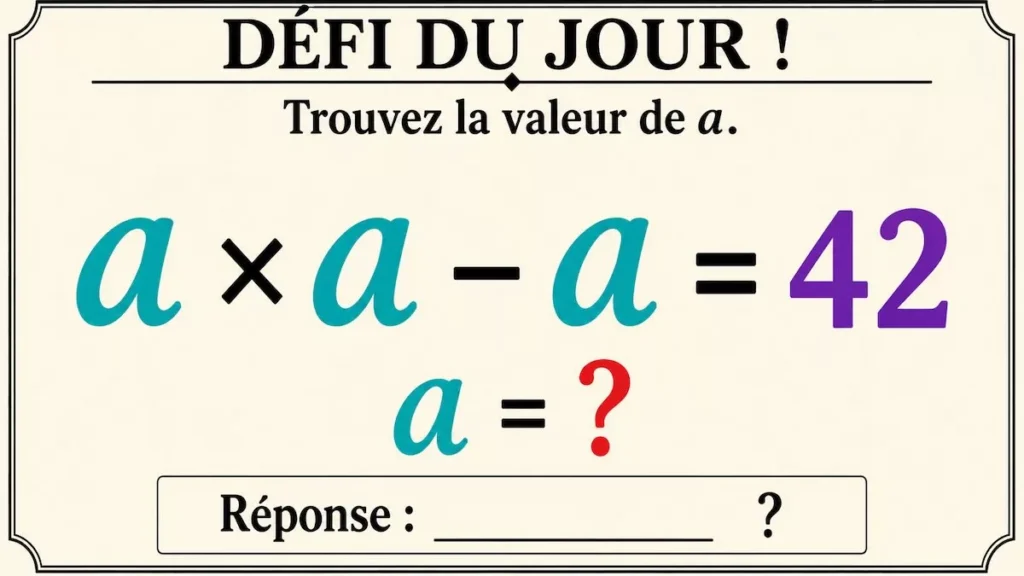
Today, we need to find the value of a from the equation:
Question:
What is the value of a?
Be careful: it may be tempting to immediately guess a random number. Instead, try to identify a method that allows you to solve the equation properly.
You have 30 seconds.
Countdown Begins
30…
25…
20…
15…
10…
5…
4…
3…
2…
1…
Time’s up!
What Your Performance Can Reveal
If you found the result quickly and correctly, you have excellent logic and good analytical skills.
If you found the result after some thought, you know how to structure your reasoning and verify your steps.
And if your result was incorrect or not found, no worries, this type of exercise is perfect for improving your method and accuracy.
Detailed Solution We Found (not necessarily the only or correct one)
We start with the equation:
a² − a = 42
Let’s move 42 to the left:
a² − a − 42 = 0
Now we need to find two numbers such that:
- the product is −42;
- the sum is −1.
These two numbers are −7 and 6.
We can then factor:
(a − 7)(a + 6) = 0
For the product to equal zero, one of the two factors must be zero.
First case:
a − 7 = 0
Therefore:
a = 7
Second case:
a + 6 = 0
Therefore:
a = −6
Verification
With a = 7:
7 × 7 − 7 = 49 − 7 = 42
That works.
But let’s also verify a = −6:
(−6) × (−6) − (−6)
36 + 6 = 42
That also works.
Mathematical Answer: a = 7 or a = −6
Conclusion
This challenge hides an interesting subtlety: the equation has two solutions, not just 7. Quickly finding 7 is good intuition, but completely solving the equation reveals that −6 also works. This is precisely the point of mathematics: it teaches us not to stop at the first answer that seems correct, but to check if all possibilities have been considered.
If you found 7, well done! And if you also identified −6, you took your reasoning all the way to the end.