For centuries, mathematics has allowed us to assign value to what we do not yet know. Ancient scholars were already solving problems involving unknown quantities long before the modern use of letters such as a, b, or c. With the development of algebra, these unknowns became much easier to manipulate. This concept has had immense consequences. Today, equations are used to design buildings, predict trajectories, create machines, program computers, and model scientific phenomena. However, their significance extends beyond major discoveries: solving an equation also trains our brains to organize information and proceed methodically.
I remember a problem that involved three unknowns at once. At first, I thought it would require a lengthy series of calculations. Then, by starting with the simplest equation, the other values revealed themselves almost effortlessly. This is an important lesson: in mathematics, the choice of starting point can be as crucial as the calculations themselves.
Quote of the Day
“Mathematics is the music of reason.” — James Joseph Sylvester
This quote serves as a reminder that mathematics has a form of harmony: each piece of information can resonate with others until a logical solution emerges.
What This Challenge Allows You to Work On:
- Solving multiple interrelated equations;
- Squares and square roots;
- Substitution;
- Isolating an unknown;
- Mental calculation;
- The logical order of steps;
- Concentration and speed;
- Verifying a result.
Challenge of the Day
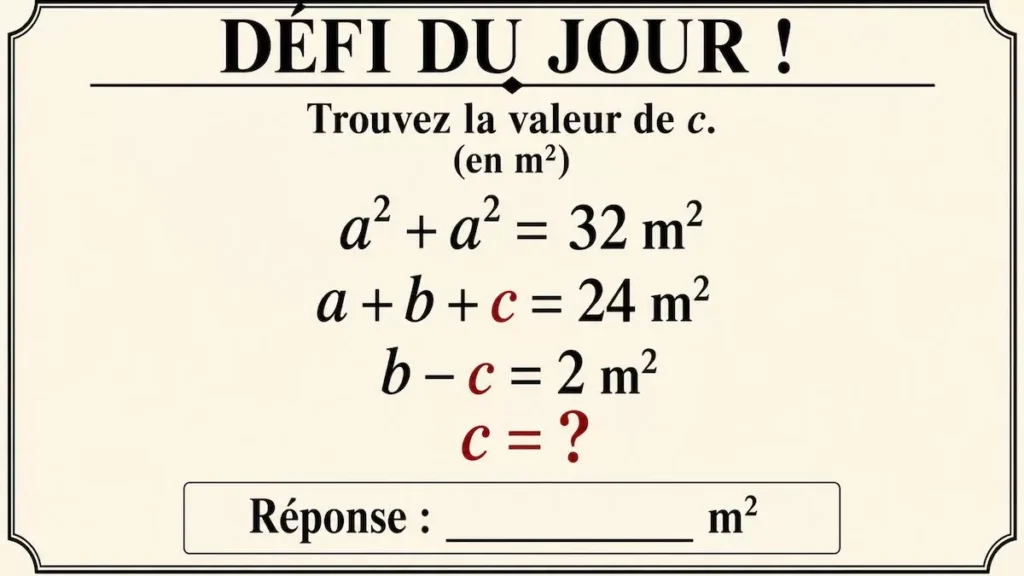
Today, we need to find the value of c.
Here are the equations: for this challenge, we consider the positive value
Question:
What is the value of c?
Observe the three equations carefully. Only one of them allows you to find the first unknown immediately.
You have 30 seconds!
Countdown Begins
40…
30…
25…
20…
15…
10…
5…
4…
3…
2…
1…
Time’s up!
What Your Performance Can Reveal
If you found the result quickly and correctly, you have excellent logic and analytical skills.
If you found the result after some thought, you can structure your reasoning and verify your steps.
And if you found an incorrect result or none at all, don’t worry; this type of exercise is perfect for improving method and precision.
Detailed Solution We Found (Not Necessarily the Only One, Sometimes Even the Right One)
Let’s begin with the first equation: a² + a² = 32
The two terms are identical, so: 2a² = 32
We divide by 2:
a² = 16
For this challenge, we consider the positive value:
a = 4
Now we can use the second equation: a + b + c = 24
By replacing a with 4:
4 + b + c = 24
So: b + c = 20
We also have: b − c = 2
Thus, we have:
b + c = 20
b − c = 2
Let’s add the two equations: 2b = 22
Therefore: b = 11
Now we just need to find c.
From: b − c = 2
We replace b with 11: 11 − c = 2
So:
c = 9
Verification
Let’s check with the second equation:
a + b + c = 24
4 + 11 + 9 = 24
24 = 24
Everything is correct.
Answer: c = 9
Conclusion
This challenge demonstrates that a system of multiple equations is not necessarily complicated. The key is to start with the information that allows for an immediate value, then use that value in subsequent equations. We sequentially found a = 4, then b = 11, and finally c = 9. This is precisely what mathematics teaches: to learn not to tackle all information at once, but to build reasoning step by step. If you found 9 before the 30 seconds were up, challenge accomplished!
And before you get lost in the depths of the web, explore other games and tests by clicking here.