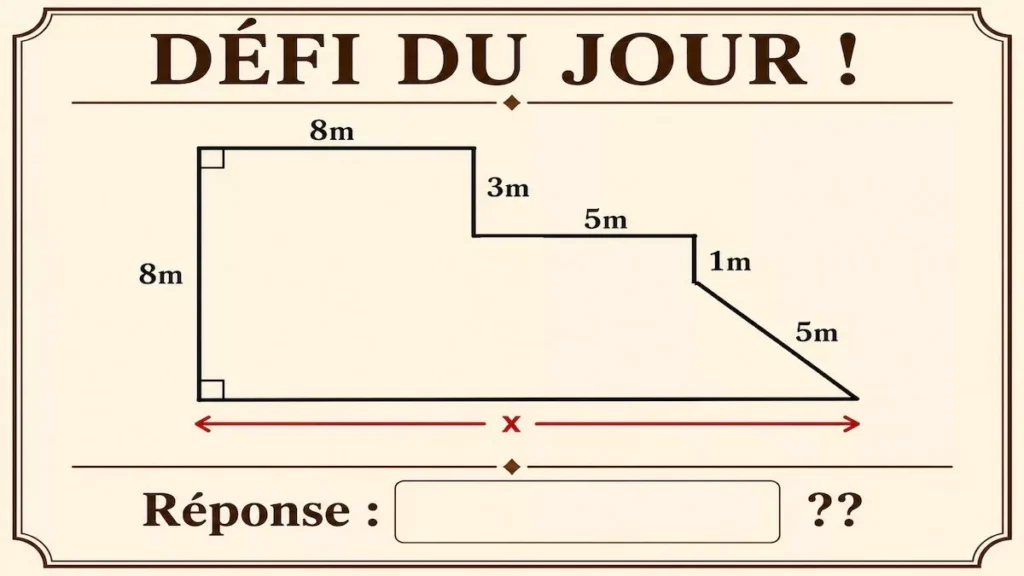
Geometry originated from a very practical need: measuring distances, dividing land, and constructing with precision. From ancient surveyors to today’s architects and engineers, the same principles are employed to determine lengths that cannot be directly measured. This is one of the aspects I appreciate about mathematics: a figure that appears complex can often be broken down into much simpler shapes. This challenge reminds me of those little problems where my first instinct would be to add up all the visible lengths.
However, in this case, that’s not enough. It’s essential to first observe the horizontal and vertical movements, and then identify that a right triangle is concealed within the sloped part. This is when the drawing truly starts to “speak.”
“Geometry is the art of reasoning correctly from incorrect figures.” — Henri Poincaré
This quote fits particularly well with this challenge: the drawing aids our understanding of the situation, but it is the measurements and reasoning that lead to the exact answer. Therefore, one should not rely solely on what the eye thinks it sees.
What This Challenge Allows You to Work On:
- Careful reading of a geometric figure.
- Identifying horizontal and vertical lengths.
- Decomposing a complex figure, applying the Pythagorean theorem.
- Recognizing a right triangle.
- Solving an equation.
- Calculating missing lengths.
- Logical reasoning.
- Mental calculation.
- Verifying the coherence of the result.
The Challenge
The figure has a total height of 8 m.
What is the total length x represented at the bottom of the figure?
Take a moment to observe the drawing before continuing. Part of the sought length is not provided directly.
The Countdown Begins
40…
30…
25…
20…
15…
10…
5…
4…
3…
2…
1…
Time’s up!
What Your Performance May Reveal
If you found the result quickly and accurately, you have excellent logical reasoning and analytical skills.
If you arrived at the result after some thought, you are able to structure your reasoning and check your steps.
And if the result was incorrect or not found, no worries; this type of exercise is perfect for improving your method and precision.
Detailed Solution We Found (Not Necessarily the Only One, and Sometimes Not Even the Right One)
Let’s start by determining the remaining height at the level of the sloped segment.
The total height is:
8 m
The two descents already made measure:
3 m + 1 m = 4 m
Therefore, the height remaining to the base is:
8 − 4 = 4 m
The sloped segment of 5 m forms the hypotenuse of a right triangle.
Let’s call d the missing horizontal length.
Using the Pythagorean theorem:
d² + 4² = 5²
d² + 16 = 25
d² = 9
Since a length is positive:
d = 3 m
We can now calculate the total length x.
It corresponds to the three horizontal movements:
x = 8 + 5 + 3
x = 16 m
Answer
x = 16 m
Conclusion
This challenge demonstrates that a total length is not necessarily found by immediately adding the numbers displayed on a figure. It is crucial to first understand how the different parts are organized and to find the missing measurement.
The key point here was to discover a right triangle with sides 3 m, 4 m, and 5 m. Once this horizontal length of 3 m was determined using the Pythagorean theorem, the final calculation became very straightforward.
Final count: 8 m of height, 4 m of known descent, 4 m of remaining height, a right triangle 3-4-5, then 8 + 5 + 3 = 16 m.
The sought length is therefore x = 16 m.
And before you get lost in the depths of the web, explore more games and tests by clicking here.