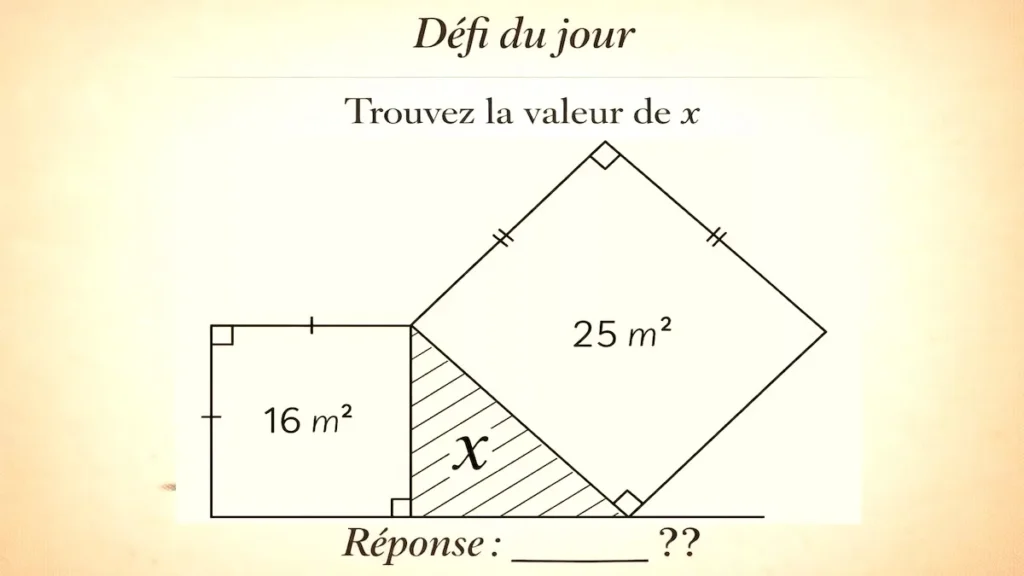
I remember a geometry challenge where several people tried to guess the answer just by looking at the given dimensions. However, in mathematics, the best approach is not to rely solely on intuition but to understand the relationships between figures. This is what makes math so fascinating: it develops logic, concentration, precision, and the ability to solve problems step by step. Geometry teaches us to observe shapes, use the right properties, and transform a figure into clear reasoning.
In this challenge, you will need to use the information given about the squares to find the unknown value of the triangle. The difficulty arises not only from calculations but also from the ability to analyze the situation and find the connection between the different figures.
As Euclid said:
“The laws of geometry are based on reasoning and proof.”
This reminds us that in mathematics, every answer must be constructed methodically.
What This Challenge Allows You to Work On:
- Properties of geometric figures
- Conversion between area and length
- Logical reasoning
- Analysis of a diagram
- Solving for an unknown
The Challenge of the Day
Answer: ______ ??
Take your time to observe the information before responding.
Every piece of data is a clue that helps you move toward the solution.
The countdown begins:
50…
40…
30…
20…
10…
5…
4…
3…
2…
1…
Time’s up!
What Your Performance Can Reveal
If you found the result quickly and correctly, you have excellent logic and good analytical skills.
If you found the result after some thought, you know how to structure your reasoning and check your steps.
And if your result is incorrect or not found, no worries, this type of exercise is perfect for improving method and precision.
Detailed Solution We Found (Not Necessarily the Only One, Sometimes Even the Correct One)

To solve this challenge, we first need to find the dimensions of the squares based on their areas:
Left square:
√16 = 4 m
Right square:
√25 = 5 m
The value of the triangle then depends on the geometric relationship indicated in the figure (the position of the triangle, lengths used, and the required formula).
Final Answer:
The left square has an area of 16 m², so its side measures 4 meters.
This side corresponds to the height of the shaded triangle.
The right square has an area of 25 m², so its side measures 5 meters.
This side corresponds to the diagonal (the hypotenuse) of the shaded triangle.
The Shaded Triangle is a Right Triangle.
To find its base, we use the Pythagorean theorem: base squared + 4 squared = 5 squared.
This gives: base squared + 16 = 25.
The base squared is therefore equal to 9 (25 – 16), and the base measures 3 meters.
The area of the triangle (x) is calculated by multiplying the base by the height and then dividing by 2: (3 x 4) / 2 = 12 / 2 = 6.
The value of x is 6 m².
Conclusion
This challenge shows that geometry primarily requires understanding the relationships between figures. Mathematics teaches us