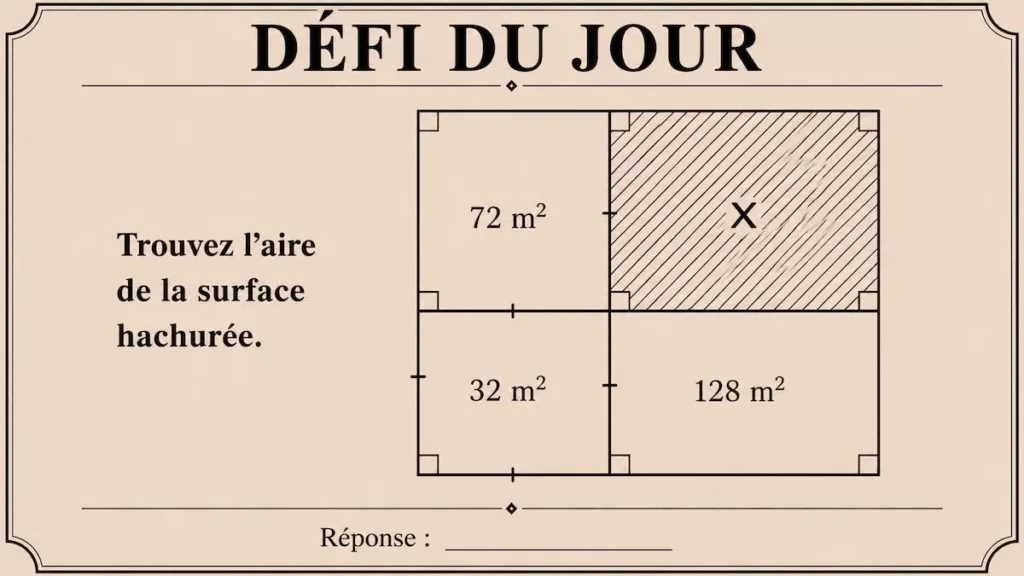
I have often found myself looking at a plan made up of several areas and thinking that some dimensions were missing to solve the problem. Then, by observing the marks on the sides and the areas already indicated, I realized that all the information was actually present. This is what I appreciate about geometry: it teaches us not to stop at what is written in large but to look for the small clues that connect the entire figure.
For thousands of years, the calculation of lengths and areas has accompanied humanity’s great achievements. It has been used to delineate land, construct monuments, and later design roads, bridges, buildings, and machines. Today, these same principles remain essential in architecture, engineering, and many technologies. Working with them develops our logic, precision, observational skills, and our ability to solve problems progressively.
“Mathematics is a workout for the mind and preparation for philosophy.” — Isocrates
This quote fits well with this challenge: the real exercise is not just calculating but understanding how each piece of information can lead us to the next.
What this challenge allows you to work on:
- Properties of squares
- Calculating areas
- The relationship between length and area
- Geometric logic
- Solving for an unknown
Challenge of the Day
What is the value of X?
The figure contains four areas.
Three areas are known.
The fourth area is shaded and represented by X.
What is the area of the shaded surface?
Answer: __________ m²
Pay close attention to the equal marks on the sides. They hold the key to the problem.
Countdown Begins
50…
40…
30…
20…
10…
5…
4…
3…
2…
1…
Time’s up!
What Your Performance Can Reveal
If you found the answer quickly and correctly, you have excellent logic and analytical skills.
If you found the answer after some thought, you know how to structure your reasoning and check your steps.
And if the result is incorrect or not found, no worries; this type of exercise is perfect for improving your method and accuracy.
Detailed Solution We Found (not necessarily the only or the correct one)
Let’s start with the area of 32 m².
The marks on the figure indicate that its width and height are equal: it is a square.
Let’s call a the length of its side.
We can write the equation:
a² = 32
Thus:
a = √32 = 4√2 m
Now, let’s look at the rectangle of 72 m².
Its width is also 4√2 m.
Let’s call h its height:
4√2 × h = 72
Thus:
h = 72 ÷ 4√2
h = 9√2 m
Now, let’s look at the rectangle of 128 m².
Its height corresponds to the side of the square of 32 m², which is 4√2 m.
Let’s call L its width:
4√2 × L = 128
Thus:
L = 128 ÷ 4√2
L = 16√2 m
The shaded area has the same width L and height h.
We can thus write the equation:
X = (16√2) × (9√2)
Since:
√2 × √2 = 2
We obtain:
X = 16 × 9 × 2
X = 288 m²
Final Answer
X = 288 m²
An Even Faster Method
We can also notice a very elegant relationship between the four areas:
72 × 128 = 32 × X
Thus:
X = (72 × 128) ÷ 32
X = 288 m²
Conclusion
This challenge perfectly illustrates how several areas can be interconnected without all their dimensions being directly indicated. By using length equalities and constructing the right equations, we can progressively uncover the unknown area. This ability to transform a figure into reasoning is what makes mathematics so useful: it teaches us to observe, establish relationships, and methodically move toward a verifiable solution.
And before you get lost in the depths of the web, explore other games and tests by clicking here.