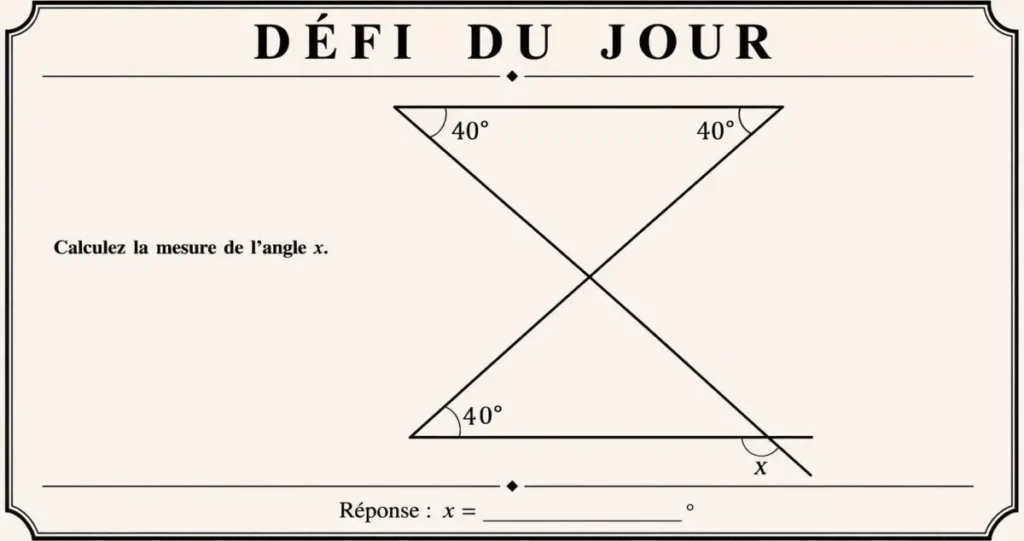
I remember a geometry exercise where two long lines intersected in the middle of the figure. My first instinct was to look for a complicated formula related to the intersection point. However, the solution lay simply in the angles of the triangles and a property we learn very early on. This is what I appreciate about mathematics: they compel us to slow down, observe the relationships between elements, and construct our reasoning rather than guess.
The geometry of angles has a very ancient history. Astronomers, navigators, architects, and surveyors have long used angles to determine directions, measure distances, or construct structures with precision. Principles studied over two thousand years ago are still present today in architecture, cartography, engineering, robotics, and even navigation systems. These simple exercises therefore train a way of reasoning that goes far beyond the classroom.
“The essence of mathematics is freedom.” — Georg Cantor
I find this quote fitting for this challenge, as the same figure can often be approached in multiple ways. The key is to find a coherent line of reasoning and be able to verify it.
What This Challenge Allows You to Work On:
- The sum of the angles in a triangle
- The angles opposite to each other at the vertex
- Supplementary angles
- Exterior angles
- Reading a figure
- Setting up equations
- Mental calculations
- Logic and concentration
DAILY CHALLENGE
Calculate the measure of angle x.

What is the value of x?
Answer: x = __________ °
Carefully observe the intersection point: it connects the upper triangle to the lower one.
Countdown Begins
50…
40…
30…
20…
10…
5…
4…
3…
2…
1…
Time’s up!
What Your Performance Can Reveal
If you found the answer quickly and correctly, you have excellent logic and strong analytical skills.
If you found the answer after some thought, you know how to structure your reasoning and verify your steps.
And if your answer was incorrect or not found, no worries; this type of exercise is perfect for improving your method and precision.
Detailed Solution We Found (Not Necessarily the Only One, Sometimes Even the Right One)
Let’s begin with the triangle located at the top.
Its first two angles measure:
40°
and:
40°
Let’s denote the angle at the intersection point as y. Since the sum of the angles in a triangle is equal to 180°, we can set up the equation:
40° + 40° + y = 180°
Thus:
80° + y = 180°
Subtracting 80° from both sides gives:
y = 100°
Now let’s look at the point where the two lines intersect.
The angles opposite each other at the vertex are equal. Therefore, the angle in the lower triangle at the intersection point also measures:
100°
In the lower triangle, we now know two angles:
40°
and:
100°
Let’s call its third interior angle z.
We can set up the equation:
40° + 100° + z = 180°
140° + z = 180°
Thus:
z = 40°
But be careful: on the diagram, x is not the interior angle z. It is the adjacent exterior angle. These two angles together form a straight angle.
So we write:
x + 40° = 180°
Subtracting 40° gives:
x = 140°
Final Answer
x = 140°
Verification
Upper triangle:
40° + 40° + 100° = 180°
Lower triangle:
40° + 100° + 40° = 180°
Exterior angle:
40° + 140° = 180°
Everything is therefore consistent.
Conclusion
This challenge is interesting because it requires three successive lines of reasoning. First, we find 100° using the upper triangle. The angles opposite each other at the vertex then allow us to transfer this information to the lower triangle. We then obtain an interior angle of 40°, before