I remember a logic challenge where everyone was convinced that complicated calculations were necessary. After a few minutes, someone simply said, “What if we look for a pattern instead of a formula?” That was when everyone began to see the problem in a new light. This is also what I love about mathematics: it teaches us to observe, make connections, and reason methodically rather than responding randomly. Mathematics is not just about adding or multiplying numbers; it cultivates logic, memory, concentration, and the ability to recognize patterns. These skills are invaluable, both in school and in everyday life.
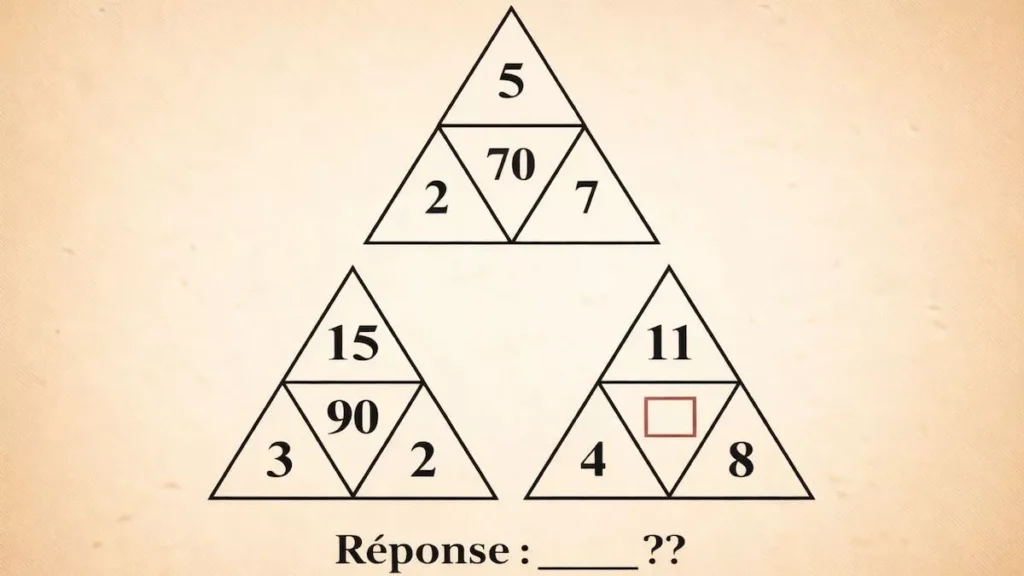
In this challenge, the goal is not to apply a classic formula, but to uncover the hidden pattern that connects the numbers in each triangle. Take the time to observe before calculating: the solution is often simpler than it appears.
As Henri Poincaré said:
“Mathematics is not about calculating, but about understanding.”
What This Challenge Helps You Work On:
- Pattern recognition
- Deductive logic
- Observation of regularities
- Concentration
- Mathematical reasoning
The Challenge of the Day
Find the pattern.
Answer: ______ ??
Take a moment to observe the three triangles. The relationship between the numbers is key to this challenge.
The countdown begins:
30…
20…
10…
5…
4…
3…
2…
1…
Time’s up!
What Your Performance Can Reveal
If you found the answer quickly and correctly, you have excellent logic and analytical skills.
If your answer was incorrect or you didn’t find one, no worries; this type of exercise is perfect for improving method and precision.
Detailed Solution We Found (Not Necessarily the Only One)
We are looking for the rule that connects the first three numbers to the fourth.
For the first triangle:
5 × 2 × 7 = 70
For the second triangle:
15 × 3 × 2 = 90
We apply the same logic to the third triangle:
11 × 4 × 8 = 352
Final Answer:
352
Conclusion
This challenge illustrates that in mathematics, it is not always necessary to perform complex calculations. The difficulty often lies in the ability to spot a logical pattern. By taking the time to observe the information and proceeding step by step, one discovers that the solution is often simpler than it seems. Mathematics trains us to develop this analytical and reflective capability.
And before you get lost in the depths of the web, explore other games and tests by clicking here.