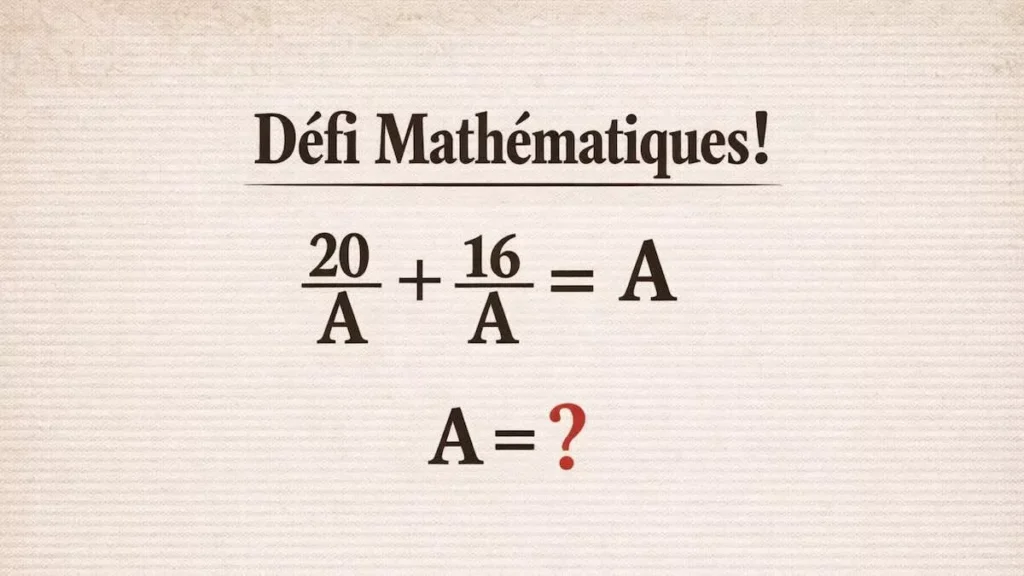
Some equations may seem very simple, but they actually require a solid mastery of algebraic rules to be solved correctly. This type of problem relies more on precision and logic than on speed. Before you dive in, take the time to analyze the structure of the equation. The goal is not to guess randomly, but to understand how to simplify and transform the equality in a rigorous manner.
A Reflection in the Spirit of Évariste Galois
As Évariste Galois pointed out:
“It takes courage to face the truth.”
In mathematics, this means following a clear logic, even when the result isn’t immediately obvious.
Why This Challenge Is Interesting
This exercise helps develop several essential skills:
- Simplifying algebraic fractions
- Factoring and reducing expressions
- Managing an unknown in the denominator
- Maintaining rigor in equation transformations
- Ability to verify the validity of the result
Here Is The Challenge
Take your time to observe carefully.
The Countdown
30…
20…
10…
5…
3…
2…
1…
Time’s up!
What Your Performance Reveals
If you found the result quickly and correctly, you have a strong grasp of operational priorities and your reasoning is clear and methodical.
If you found the result after some reflection, you know how to verify your calculations and follow a structured method.
If the result was incorrect or not found, no problem—these exercises are designed to train precision, rigor, and mathematical logic.
Here Is The Solution We Found
Method to Follow
To solve this equation, it is advisable to:
- Group like terms
- Simplify the expression
- Eliminate the denominator if necessary
- Isolate the unknown
Each step must maintain the balance of the equation.
Detailed Resolution
Let’s start by grouping the fractions:
20/A + 16/A = 36/A
The equation becomes:
36/A = A
To eliminate the denominator, we multiply each side by A (assuming A ≠ 0):
36 = A²
We then obtain:
A² = 36
Taking the square root:
A = 6 or A = -6
Result
The solutions to the equation are:
A = 6 or A = -6
Conclusion
This challenge shows that an equation that appears very simple can lead to multiple solutions. It also highlights the importance of handling fractions carefully and never forgetting about the conditions of existence (in this case, A ≠ 0).
By applying a clear and rigorous method, one can arrive at a correct and complete result.
And before you get lost in the web’s maze, explore other games and tests by clicking here.