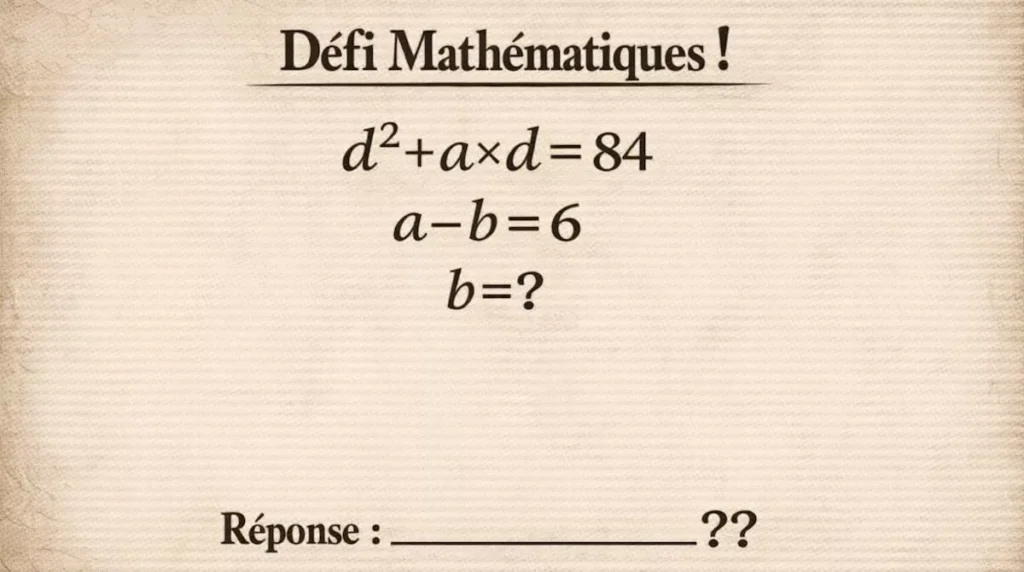
Behind a system of equations that may seem simple lies a more subtle reasoning than it appears. Without careful analysis, it’s easy to overlook an important detail. Many people seek a quick answer without truly taking the time to structure their thinking. Moreover, it is often said that the level of mathematics is declining in France.
This type of challenge is an excellent opportunity to strengthen logical reasoning, review the basics, and make progress in mathematics. Here, it’s not just about speed; method and rigor matter as well.
As René Descartes said:
“To properly conduct one’s reason, it must be directed with order.”
In mathematics, this means that a structured approach is essential to arrive at the correct result.
What This Challenge Allows You to Work On
- Manipulating algebraic expressions
- Solving systems of equations
- Using remarkable identities
- Rigor in calculations
- Verifying results
The Challenge of the Day
Answer: ______ ??
Take the time to analyze the equations before jumping into calculations.
Method to Follow
To solve this problem, it is advisable to:
- Utilize both equations to find a and b
- Use identities to simplify calculations
- Substitute values into the final equation
- Calculate step by step
The Countdown
60…
50…
40…
30…
20…
10…
5…
3…
2…
1…
Time’s up!
So, what is your answer?
What Your Performance Reveals
If you found the answer quickly and correctly, you have excellent analytical skills.
If you arrived at the answer after some reflection, you know how to structure your reasoning.
If your answer was incorrect or you didn’t find one, no problem; these challenges are meant for progress.
Detailed Solution We Found (Not Necessarily the Only or Even the Correct One)
Step 1: Express a
From the second equation:
a = b + 6
Step 2: Substitute into the First Equation
We substitute a:
Expand:
Step 3: Factorization
We factor out d:
Step 4: Find Possible Values
We need to find two numbers whose product is 84.
Let’s test a simple pair:
So we can set:
Step 5: Solve
Complete Verification
Final Answer:
b = 2
Conclusion