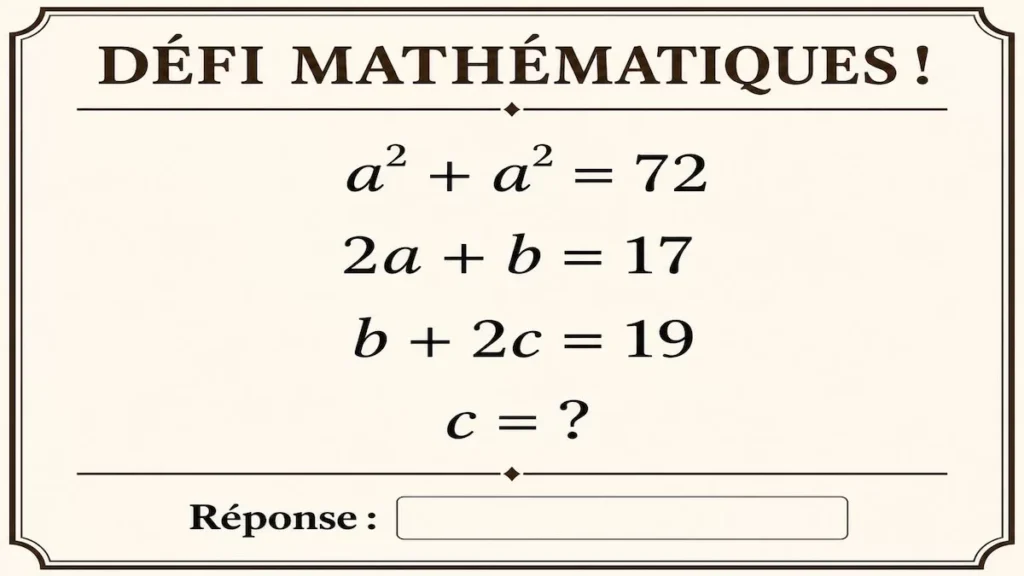
For centuries, mathematics has accompanied humanity’s great advancements. It has enabled us to measure land, construct monuments, understand the movement of celestial bodies, and later develop sciences, computer science, and modern technologies. Behind all these achievements lies a common approach: observing, reasoning, and utilizing available information to uncover the unknown.
What I particularly enjoy about such challenges is the feeling of conducting a small investigation. At first, the letters a, b, and c seem to conceal their values. However, one equation provides a clue, which helps solve the next one, and gradually everything becomes clear.
This is precisely what makes mathematics fascinating: a solution that appears complex can become quite simple when approached in the right order.
“The only way to learn mathematics is to do mathematics.” — Paul Halmos
What This Challenge Allows You to Work On:
- Solving simple equations
- Understanding squares and square roots
- Using a condition like a > 0
- Substituting a value into a new equation
- Logical sequencing of multiple equations
- Mental calculation
- Maintaining rigor in the steps
- Verifying the result
- Concentration
- Mathematical reasoning
The Challenge
Consider the following equations:
What is the value of c?
Note: Before you begin, take a good look at the first equation.
A single equation can sometimes lead to multiple possibilities.
The Countdown Begins
40…
30…
25…
20…
15…
10…
5…
4…
3…
2…
1…
Time’s up!
What Your Performance Can Reveal
If you found the result quickly and correctly, you have excellent logic and strong analytical skills.
If you found the result after some reflection, you know how to structure your reasoning and check your steps.
And if your result was incorrect or you couldn’t find it, no worries—this type of exercise is perfect for improving your method and precision.
Detailed Solution We Found (Not Necessarily the Only One, Sometimes Even Correct)
Let’s start with the first equation:
a² + a² = 72
2a² = 72
a² = 36
Thus:
a = 6 or a = −6
And this is where the challenge becomes interesting: the prompt does not specify that a > 0. Therefore, there are two possibilities.
First Case: a = 6
Second equation:
2a + b = 17
2 × 6 + b = 17
12 + b = 17
b = 5
Third equation:
b + 2c = 19
5 + 2c = 19
2c = 14
c = 7
Second Case: a = −6
Second equation:
2a + b = 17
2 × (−6) + b = 17
−12 + b = 17
b = 29
Third equation:
b + 2c = 19
29 + 2c = 19
2c = −10
c = −5
Answer
With the information provided on the prompt, there are two possible answers:
c = 7 or c = −5
If the intention of the challenge was to obtain only c = 7, the condition a > 0 should have been added to the prompt.
Conclusion
This challenge reveals an important lesson: solving an equation correctly involves more than just performing calculations. It also requires examining all possible solutions. Since a² = 36, one cannot automatically choose a = 6: a = −6 is equally valid unless an additional condition excludes it.
This is precisely what makes this small exercise intriguing. A few very simple equations allow for practice in both calculation and rigorous reasoning.
Final count: 3 equations, 2 possible values for a, 2 paths to resolution, and 2 possible answers for c: 7 or −5.
And before you get lost in the depths of the web, explore other games and tests by clicking here.