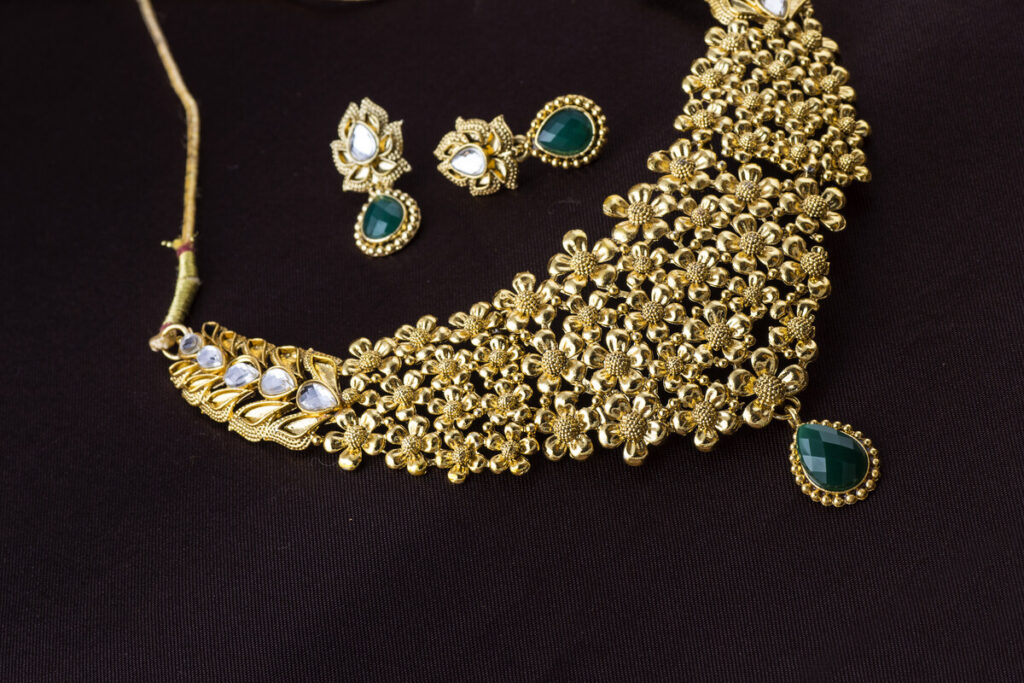
Before you walk into a jeweller and compare necklaces, learn three numbers: the karat, the weight in grams and the rate per gram. With them, you can work out what any gold piece is worth in about a minute.
Number 1: the karat tells you how much of the piece is gold
Pure gold is soft, so jewellery is made from an alloy: gold mixed with other metals. These metals make the piece harder and more durable, and they also lower the cost per weight. The karat shows how many parts out of 24 are gold.
Pure gold share = karat ÷ 24. So 24 karat is treated as 100% gold, 22 karat is 22 ÷ 24 = 91.67%, and 18 karat is 18 ÷ 24 = 75%. You will also see the same purity written as a three-digit number: 916 for 22 karat and 750 for 18 karat. 22 karat (916) is the standard for jewellery in India, while 18 karat (750) is common in Europe and is used for stone-set pieces because the metal needs to be hard enough to hold a stone in place.
Number 2: the weight tells you how much pure gold you get
Multiply the weight by the gold share. A 10 g chain in 22 karat holds 10 × 22 ÷ 24 = 9.17 g of pure gold. The same 10 g in 18 karat holds only 10 × 18 ÷ 24 = 7.5 g. Same weight on the scale, very different amount of gold.
Number 3: the rate per gram has to match the karat
Shops usually advertise one headline rate, normally for 24 karat. Your piece is not 24 karat, so scale the rate down: rate for your karat = 24 karat rate × karat ÷ 24.
Say the 24 karat rate is ₹10,000 per gram (an illustrative figure, not today’s market price). Then:
- 22 karat: 10,000 × 22 ÷ 24 = ₹9,166.67 per gram
- 18 karat: 10,000 × 18 ÷ 24 = ₹7,500 per gram
A worked example: a 20 g necklace in 22 karat
Metal value = 20 g × ₹9,166.67 = ₹1,83,333. Now suppose the jeweller adds a making charge of 8% of the metal value (again, an illustrative figure, so always ask for the real one). That is 8% of ₹1,83,333 = ₹14,667, which brings the total to ₹1,98,000 before any taxes shown on the bill. If you want to understand how a percentage added on top of a cost works, see our guide to markup vs margin.
Comparing 22 karat with 18 karat
For 10 g, the metal costs ₹91,667 in 22 karat and ₹75,000 in 18 karat, a gap of ₹16,667. Per gram, 22 karat metal costs 22 ÷ 18 = 1.22 times as much, or about 22% more. That is not a rip-off: you are simply paying for more gold. The real question is whether you want a softer, purer piece or a harder, cheaper one.
Common mistakes to avoid
- Comparing prices without comparing karats. An 18 karat piece priced at the 22 karat rate is overpriced by the same 22 ÷ 18 factor.
- Trusting a stamp alone. A hallmark is a mark that certifies the metal content, and it only counts if an independent body guarantees it. A number stamped by the maker alone is not strictly a hallmark. Look for the official mark, not just “916” on its own.
- Forgetting that the total includes more than metal. Making charges and taxes come on top, so ask for them as separate lines on the bill, then do the same arithmetic for every shop you compare.
- Weighing stones as gold. If a piece has stones, ask for the weight of the gold separately, since only that part is priced at the gold rate.
With the karat, the weight and the rate in hand, two quotes for what looks like the same necklace become easy to compare line by line.