There is something fascinating about the history of mathematics. The rules we learn today in just a few minutes are the result of centuries of thought. As calculation methods have been refined, mathematicians have established common conventions so that the same equation yields the same result, regardless of who solves it. These rules have become essential far beyond the classroom. Computer science, engineering, the sciences, finance, architecture, and space exploration all rely on calculations that must be performed in a specific order. A tiny mistake in prioritization can completely alter a result.
In this type of calculation, it is common to want to jump right into the most eye-catching operation. However, this haste can lead to an incorrect answer. When an equation contains multiple operations, it is crucial to take a moment to observe the entire equation and identify what needs to be calculated first.
Quote of the Day
“Mathematics knows no boundaries.” — David Hilbert
This phrase reminds us that the language of mathematics is universal. But for this language to work, one must adhere to the rules that give precise meaning to calculations.
What This Challenge Helps Develop:
- Order of operations;
- Multiplication and division;
- Addition;
- Mental calculation;
- Careful reading of an equation;
- Concentration;
- Ability to avoid hasty answers.
Challenge of the Day!
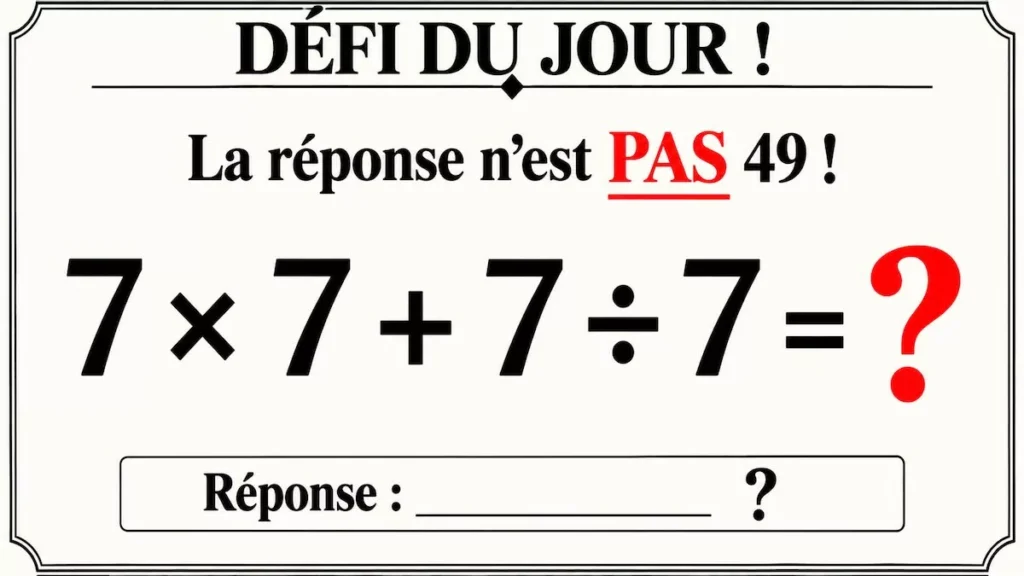
Today, we present an equation that seems extremely simple:
But be careful!
The answer is not 49.
Can you find the true result?
Before calculating, ask yourself which operations are prioritized.
You have 10 seconds!
The Countdown Begins
10…
9…
8…
7…
6…
5…
4…
3…
2…
1…
Time’s up!
What Your Performance May Reveal
If you found the result quickly and correctly, you have excellent logic and analytical skills.
If you found the result after some thought, you know how to structure your reasoning and verify your steps.
And if your result was incorrect or not found, no worries; this type of exercise is perfect for improving method and precision.
Detailed Solution We Found (not necessarily the only one, or even the right one)
The equation is:
You should not perform the operations simply in the order they appear.
Multiplication and division take precedence over addition.
So, we start with the multiplication:
7 × 7 = 49
Next, we perform the division:
7 ÷ 7 = 1
Our equation then becomes:
49 + 1
Finally, we just need to add:
49 + 1 = 50
Final Answer: 50
Why Is 49 Not the Correct Answer?
Because stopping at 7 × 7 = 49 means completely overlooking the last part of the equation.
The 7 ÷ 7 equals 1, and this result must then be added to 49.
This is precisely the small detail that makes the challenge.
Conclusion
This equation demonstrates that a calculation does not need to be complicated to test our attention. Here, all the numbers are identical, and the operations are elementary, but the order of operations makes all the difference.
If you found 50 before the countdown ended, congratulations! You resisted the lure of 49 and correctly applied the order of operations.
And this is an excellent habit to maintain: before calculating quickly, first know in what order to calculate.
And before you get lost in the depths of the web, explore other games and tests by clicking here.