Equations have accompanied some of the greatest advancements in the history of mathematics. Long before the emergence of our modern symbols, various civilizations were already seeking to determine unknown quantities from known information. Gradually, these methods gave rise to algebra, a language capable of transforming a problem into a logical sequence of steps. Today, equations are present in many fields. They allow us to model situations, predict certain phenomena, and solve problems that would be difficult to tackle with numbers alone.
In this type of challenge, a short equation may seem immediately accessible. However, it is often useful to observe its structure before diving in. Recognizing a factorization or a particular relationship between terms can facilitate a much quicker solution.
Quote of the Day
“Algebra is generous: it often gives more than one asks of it.” — Jean le Rond d’Alembert
This quote aptly illustrates the value of algebra: an equation does not merely present a calculation to perform. It also teaches us to search for relationships and organize our reasoning.
What This Challenge Allows You to Work On:
- Solving a quadratic equation;
- Factorization;
- Finding unknown values;
- Mental calculation;
- Algebraic logic;
- Attention to the various possible solutions;
- Verification of a result.
DAILY CHALLENGE!
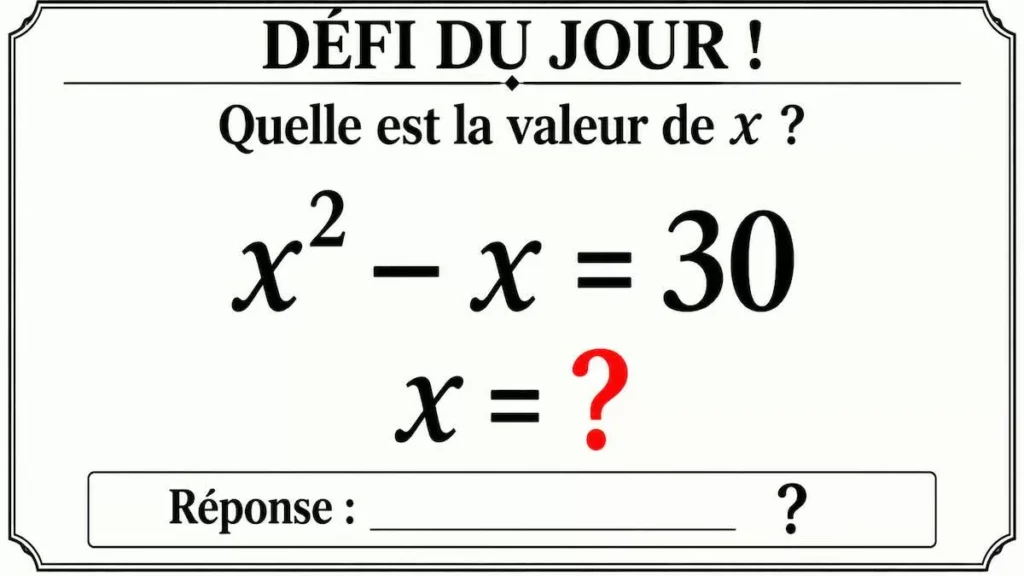
Today, you need to find the value of x in the following equation:
At first glance, one might look for a single number. But be careful: with a quadratic equation, it’s essential to consider whether there are multiple solutions.
Can you find them all?
You have 50 seconds!
Countdown Begins
50…
40…
30…
25…
20…
15…
10…
5…
4…
3…
2…
1…
Time’s up!
What Your Performance Can Reveal
If you found the result quickly and accurately, you have excellent logic and analytical skills.
If you found the result after some thought, you know how to structure your reasoning and verify your steps.
And if the result was incorrect or not found, no worries; this type of exercise is perfect for improving methodology and accuracy.
Detailed Solution We Found (Not Necessarily the Only One, or Even the Correct One)
We start with the equation: x² − x = 30
To group everything on one side, we subtract 30: x² − x − 30 = 0
Now, we need to find two numbers whose product is −30 and whose sum is −1.
These two numbers are: −6 and 5
We can then factor:
(x − 6)(x + 5) = 0
For a product to equal zero, at least one of its factors must be zero.
First case:
x − 6 = 0
Thus:
x = 6
Second case:
x + 5 = 0
Thus:
x = −5
Let’s Verify
With x = 6:
6² − 6 = 36 − 6 = 30
It works.
With x = −5:
(−5)² − (−5) = 25 + 5 = 30
This also works.
Final Answer: x = 6 or x = −5
Conclusion
The little trap of this challenge was to think that there must be only one value of x. A quadratic equation can, however, have two distinct solutions.
Here, 6 and −5 both satisfy the same equation. That’s why verification is particularly useful: it confirms that both values are correct.
This challenge thus reminds us of an important rule in mathematics: finding a solution is good, but verifying that there isn’t another one is part of the reasoning process.
And before you get lost in the depths of the web, explore other games and tests by clicking here.