Equations have a fascinating history. For centuries, mathematicians have sought methods to transform complicated problems into a series of simple and logical steps. This way of reasoning has extended far beyond classrooms; it now plays a crucial role in computing, engineering, economics, physics, and in many technologies we use daily. Thus, the value of mathematics lies not only in finding a number but primarily in teaching us to organize our reasoning, adhere to certain rules, and methodically work towards a solution.
In everyday life, problems often seem challenging because we try to solve everything at once. Once we break them down into smaller steps, they become much more manageable. This is precisely the idea behind today’s challenge.
Quote of the day
“The essence of mathematics is freedom.” — Georg Cantor
This quote serves as a reminder that mathematics allows us to explore various reasoning methods. There may be multiple paths, as long as each step is logical and well-justified.
What this challenge helps to develop:
- solving a first-degree equation;
- correct use of parentheses;
- the distributive property;
- inverse operations;
- organizing different steps of a calculation;
- mental calculation;
- focus and rigor.
Today’s challenge!
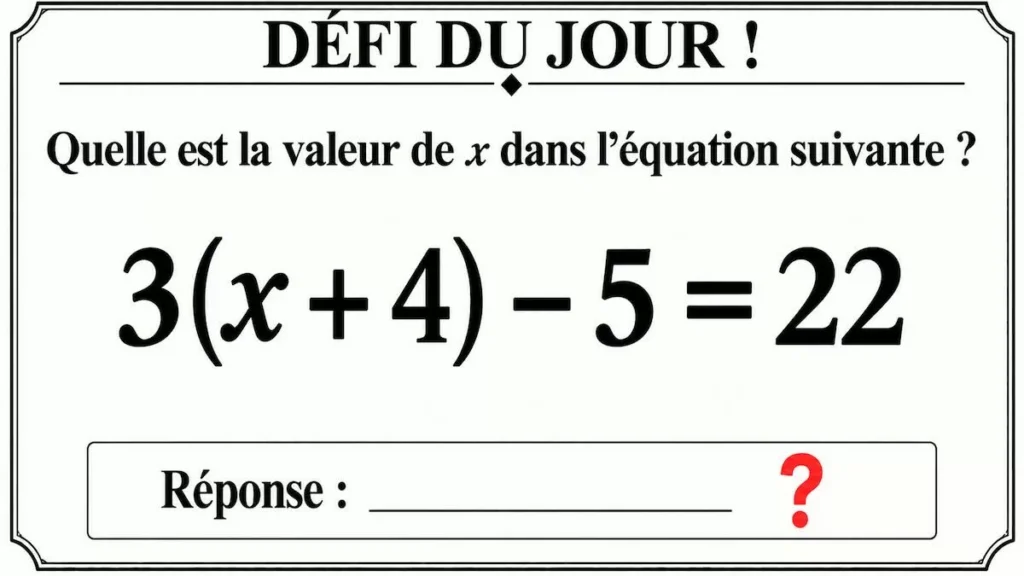
Here is the equation:
Your mission is to determine the value of x.
Don’t rush. First, observe the structure of the equation and think about the order in which you will perform the operations.
You have 40 seconds.
The countdown begins
40…
30…
25…
20…
15…
10…
5…
4…
3…
2…
1…
Time’s up!
What your performance can reveal
If you found the result quickly and accurately, you have excellent logic and analytical skills.
If you found the result after some thought, you know how to structure your reasoning and verify your steps.
And if the result was incorrect or not found, no worries; this type of exercise is perfect for improving method and precision.
Detailed solution we found (not necessarily the only or the correct one)
We start with the equation:
3(x + 4) − 5 = 22
Let’s begin by adding 5 to both sides of the equation:
3(x + 4) = 27
Now we can divide both sides by 3:
x + 4 = 9
Finally, we subtract 4 from both sides:
x = 9 − 4
Thus:
x = 5
Verification
Let’s substitute x with 5 in the original equation:
3(5 + 4) − 5
We calculate the parentheses first:
5 + 4 = 9
Then:
3 × 9 − 5
27 − 5 = 22
We indeed arrive at the result indicated in the equation.
Final answer: x = 5
Conclusion
This challenge demonstrates that an equation becomes much simpler when solved step by step. It wasn’t even necessary to expand the parentheses immediately; by first canceling the subtraction of 5 and then the multiplication by 3, we quickly reached the desired value.
This is also one of the great benefits of mathematics: learning to progressively transform a problem until its solution becomes clear.
If you found x = 5 before the countdown ended, congratulations! If not, remember the method: observe, progressively isolate the unknown, and verify the result.