For a long time, mathematics has served not only to perform calculations but primarily to identify hidden relationships. From the early numerical sequences studied in antiquity to the modern algorithms used in computer science, a common idea persists: observing multiple results to uncover the rule that links them. This ability to recognize patterns has contributed to numerous scientific achievements. It enables the modeling of natural phenomena, data analysis, computer programming, and even predicting certain behaviors based on known information.
In everyday life, we often encounter the same mechanism. When faced with a series of numbers, many instinctively start looking for a progression among the results. However, sometimes the true key lies elsewhere: in the relationship between the two numbers in each row. Taking a moment to shift perspective can completely unlock the problem.
Quote of the Day
“Mathematics is the music of reason.” — James Joseph Sylvester
This quote reminds us that mathematics has its own rhythm and logic. In a numerical challenge, discovering the rule is akin to finding the hidden rhythm behind the numbers.
What This Challenge Helps to Work On:
- Observation of numbers;
- Searching for a common rule;
- Mental calculation;
- Multiplication and addition;
- Verifying a hypothesis across multiple equations;
- Logic and deduction;
- Concentration and quick reasoning.
Challenge of the Day!
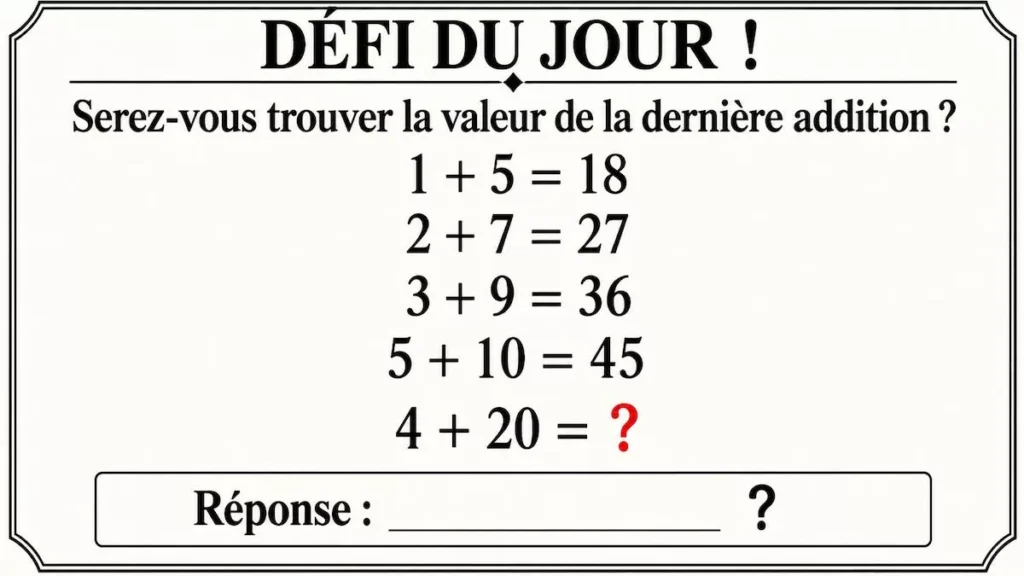
Here are several equations that deliberately do not follow the usual addition:
And now:
4 + 20 = ?
Your goal is to discover the same rule that can explain the first four equations and then apply it to the last one.
Be careful: don’t just look at the results. Consider what you could do with the two numbers on the left.
You have 30 seconds.
The Countdown Begins
30…
25…
20…
15…
10…
5…
4…
3…
2…
1…
Time’s up!
What Your Performance Can Reveal
If you found the result quickly and correctly, you have excellent logic and analytical skills.
If you found the result after some thought, you know how to structure your reasoning and check your steps.
If your result was incorrect or you didn’t find it, no worries; this type of exercise is perfect for improving your method and accuracy.
Detailed Solution We Found (not necessarily the only one, or even the correct one)
The rule becomes easier to identify when we examine each equation separately.
Let’s take the first one:
1 + 5 = 18
First, we add the two numbers:
1 + 5 = 6
Then we multiply this result by 3:
6 × 3 = 18
Let’s check with the second equation:
2 + 7 = 9
Then:
9 × 3 = 27
That works.
For the third equation:
3 + 9 = 12
Then:
12 × 3 = 36
Still correct.
Finally:
5 + 10 = 15
Then:
15 × 3 = 45
The rule is thus confirmed.
We can express it as:
(a + b) × 3
Now let’s apply this rule to the last equation:
4 + 20 = ?
We start with:
4 + 20 = 24
Then:
24 × 3 = 72
Final Answer: 72
Conclusion
This challenge serves as an important reminder: seeing a “+” sign does not necessarily mean that the result corresponds to a standard addition, especially in a riddle where a particular rule needs to be discovered.
The difficulty was not in performing lengthy calculations, but in finding a rule that applies to all the given equations. Here, we had to add the two numbers and then multiply their sum by 3.
If you found 72 before the countdown ended, congratulations! In this type of challenge, the best strategy is to propose a rule, test it on several lines, and only then apply it to the missing number.
And before you get lost in the depths of the web, explore more games and tests by clicking here.