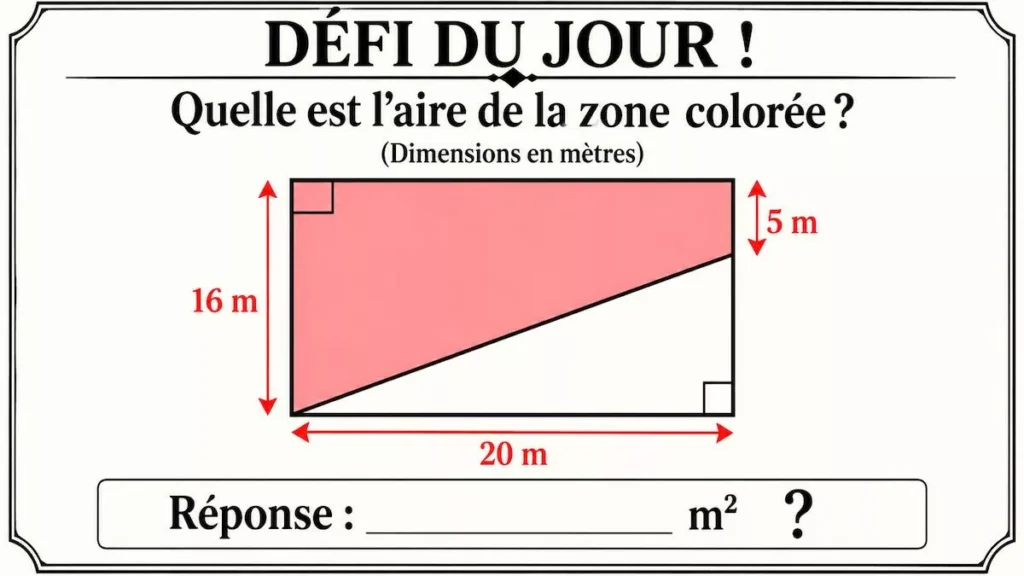
Since ancient times, geometry has allowed us to transform shapes into measurable information. The Egyptians used it to measure land, while builders and engineers employed it to design buildings, roads, and, much later, massive structures. Even today, calculating an area is essential in architecture, construction, cartography, and even to determine the quantity of materials needed for a project. What makes geometry particularly fascinating is that a figure that appears complex can often be broken down into much simpler shapes. Sometimes, it’s crucial to resist the urge to calculate immediately and start by observing the available dimensions.
It often happens that, when faced with such a drawing, one searches for a complicated formula while the solution lies simply in a rectangle and a triangle. This is a good illustration of a useful principle in mathematics: understand the figure before starting the calculations.
Quote of the Day
“Geometry is the art of reasoning correctly about incorrect figures.” — Henri Poincaré
In other words, a drawing does not need to be perfectly to scale to lead us to the correct answer. It is the dimensions and geometric properties that should guide our reasoning.
What This Challenge Helps Develop:
- Calculating the area of a rectangle;
- Calculating the area of a triangle;
- Cautious reading of a geometric figure;
- Breaking down a figure into several areas;
- Reasoning based on given dimensions;
- Selecting truly useful information;
- Concentration and logic.
Challenge of the Day!
Observe the figure closely.
The question is:
What is the area of the colored zone?
Be careful not to use all the dimensions directly without thinking.
You have 50 seconds to find the answer.
Countdown Begins
50…
40…
30…
25…
20…
15…
10…
5…
4…
3…
2…
1…
Time’s up!
What Your Performance May Reveal
If you found the result quickly and correctly, you have excellent logic and good analytical skills.
If you found the result after some reflection, you know how to structure your reasoning and check your steps.
And if your result was incorrect or not found, no worries; this type of exercise is perfect for improving your method and accuracy.
Detailed Solution We Found (Not Necessarily the Only One, or Even the Correct One)

Let’s start by determining the height located under the slanted line, on the right side.
The total height of the rectangle is 16 m, and the upper part measures 5 m.
We have the equation:
16 − 5 = 11
Thus, the height of the lower part is 11 m.
The white zone then forms a right triangle where:
- The base measures 20 m;
- The height measures 11 m.
Let’s calculate its area:
Area of the triangle = (base × height) ÷ 2
So:
Area of the triangle = (20 × 11) ÷ 2
Area of the triangle = 220 ÷ 2
Area of the triangle = 110 m²
Now let’s calculate the area of the complete rectangle:
20 × 16 = 320 m²
The colored zone corresponds to the total area of the rectangle minus the white triangle.
Thus, we obtain the equation:
320 − 110 = 210
Final Answer: 210 m²
Conclusion
This challenge perfectly illustrates why observation must precede calculation. The data of 5 m does not directly represent the height of the white triangle; one had to first understand that it allowed obtaining 11 m based on the total height of 16 m.
Once this step is identified, the problem becomes much simpler: calculate the area of the rectangle, calculate that of the white triangle, and then perform a subtraction.
If you found 210 m² before the countdown ended, congratulations! And if you needed more time, remember the method above all. Breaking down a complex figure into simpler shapes is often the best way to solve a geometry problem.
And before you get lost in the vastness of the web, explore more games and tests by clicking here.