
Number sequences hold a special place in the history of mathematics. For a long time, mathematicians have observed numbers to uncover patterns, establish rules, and predict what comes next. This search for patterns has contributed to the development of algebra as well as modern fields such as computer science, cryptography, and data analysis. The value of these challenges is that they require us to do more than just calculate. We must observe, compare, and formulate a hypothesis. In everyday life as well as in science, recognizing a pattern can help us understand a situation more quickly and anticipate its evolution.
When faced with a sequence like today’s, many people start by comparing the results to one another. This is a good approach, but it’s also important to closely examine the relationship between each number on the left and its counterpart on the right. Sometimes, a very simple rule lies behind seemingly mysterious results.
Quote of the Day
“Mathematics is the science of patterns.” — Keith Devlin
This idea perfectly aligns with the challenge: our goal is not just to perform operations, but to discover the common rule that connects all the numbers.
What This Challenge Helps To Develop:
- Observation of numerical sequences;
- Search for a logical rule;
- Understanding of number squares;
- Mental calculation;
- Recognition of patterns;
- Formulation and verification of a hypothesis;
- Concentration and speed of reasoning.
Challenge of the Day!
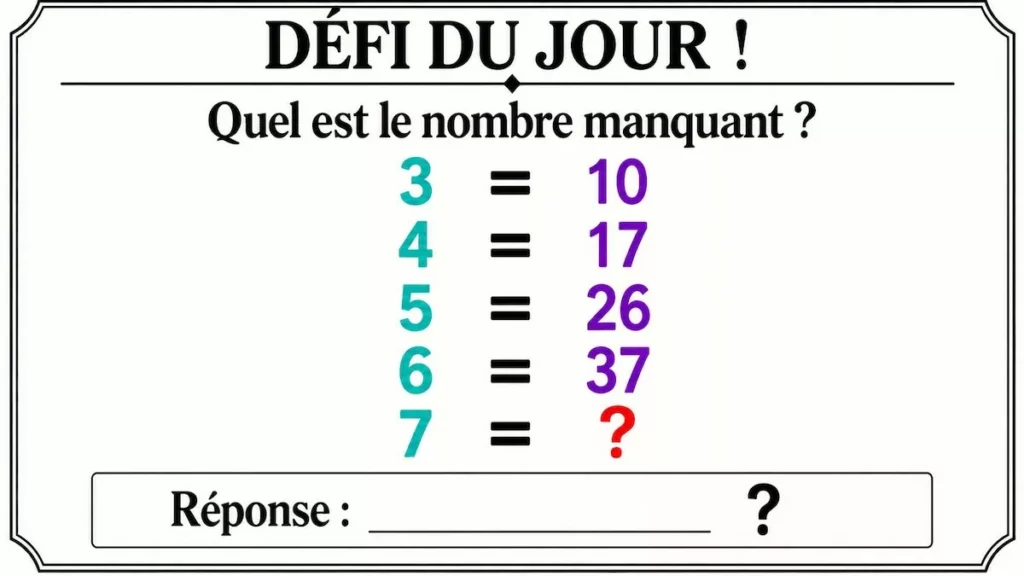
Carefully observe these equations:
7 = ?
Note: these are not ordinary mathematical equalities. Each line follows a hidden rule.
Your mission is to uncover this rule and find the corresponding number for 7.
You have 30 seconds!
The Countdown Begins
30…
25…
20…
15…
10…
5…
4…
3…
2…
1…
Time’s up!
What Your Performance Can Reveal
If you found the answer quickly and correctly, you have excellent logic and analytical skills.
If you found the answer after some thought, you know how to structure your reasoning and verify your steps.
And if your answer was incorrect or you couldn’t find it, no worries; this type of exercise is perfect for improving your method and accuracy.
Detailed Solution We Discovered (Not Necessarily the Only One, but Possibly the Right One)
Let’s take a close look at the first lines.
To go from 3 to 10, we can calculate: 3 × 3 + 1 = 10
Let’s try with 4: 4 × 4 + 1 = 17
That works.
Let’s verify with 5: 5 × 5 + 1 = 26
Still correct.
And with 6: 6 × 6 + 1 = 37
The rule is thus confirmed.
For each number, we multiply the number by itself and then add 1.
We can now apply the same rule to 7:
7 × 7 + 1
First:
7 × 7 = 49
Then:
49 + 1 = 50
Final Answer: 50
Conclusion
This challenge demonstrates that mathematics is also about observation and the search for patterns. The results 10, 17, 26, and 37 might have seemed independent at first glance, but one rule connected them all: the square of the number plus 1.
If you found 50 before the countdown ended, congratulations! And if you explored another logic, it wasn’t in vain; testing different hypotheses is part of mathematical reasoning.
The more we train our brains to spot relationships between numbers, the easier it becomes to uncover hidden rules.
And before you wander into the depths of the web, explore more games and tests by clicking here.