Geometry is one of the oldest branches of mathematics. It emerged from very practical needs: measuring land, building with precision, observing the sky, or determining distances that are difficult to measure directly. Over the centuries, this knowledge has led to the design of monuments, bridges, maps, machines, and today, digital three-dimensional models.
The value of geometry lies not only in calculating angles. It teaches us to observe a shape, identify useful information, and connect multiple properties together. In such challenges, the answer is rarely given directly; it needs to be gradually reconstructed.
When faced with a figure containing several triangles, a good approach is to avoid immediately seeking the requested angle. It is often more effective to first identify specific shapes, right angles, and equal sides. Once this information is organized, the path to the solution becomes much simpler.
Quote of the Day
“Geometry is knowledge of the eternally existent.” — Plato
This quote reminds us that geometric properties are based on precise relationships: when we recognize the correct property, it can unlock the entire figure.
What This Challenge Allows You to Work On:
- Observation of a geometric figure;
- Properties of the equilateral triangle;
- The sum of angles in a triangle;
- Complementary angles;
- Utilization of a right angle;
- Reasoning in multiple steps;
- Concentration and logic.
Challenge of the Day!
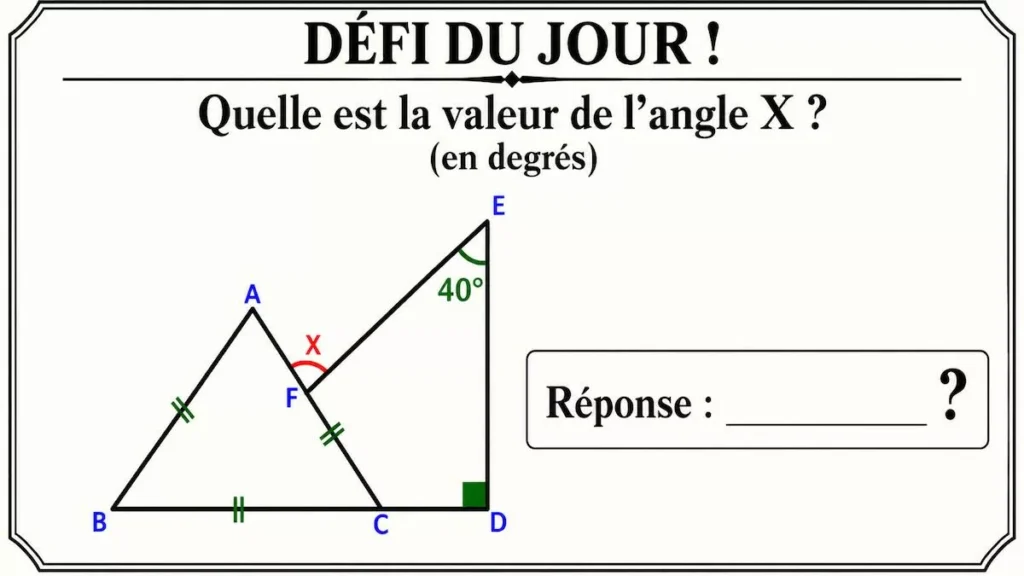
Today, your mission is to find the value of angle x.
Observe the figure carefully.
The equality marks provide essential information about the left triangle.
On the right, we also have a right angle of 90° and an angle of 40°.
All this information will help us determine the red angle x.
Can you find its value before the time runs out?
You have 40 seconds!
The Countdown Begins
40…
30…
25…
20…
15…
10…
5…
4…
3…
2…
1…
Time’s up!
What Your Performance Can Reveal
Quickly and correctly finding the answer shows that you have excellent logic and good analytical skills.
Finding the answer after some thought indicates that you can structure your reasoning and verify your steps.
And if your answer was incorrect or you couldn’t find it, no worries; this type of exercise is perfect for improving your method and accuracy.
Detailed Solution We Found (Not Necessarily the Only One)
Let’s start with triangle ABC.
The equality marks indicate that its sides are of equal length: we thus have an equilateral triangle.
In an equilateral triangle, each of the three angles measures:
60°
The line BC is horizontal. Therefore, side AC forms an angle of 60° with this horizontal line.
Now, let’s look at the right side of the figure.
The line ED is perpendicular to the base CD: we thus have an angle of:
90°
The angle at point E measures:
40°
Therefore, the line FE forms an angle with the horizontal of:
90° − 40° = 50°
We can now determine x.
At point F, the ray directed toward A corresponds to a direction of:
180° − 60° = 120°
The ray directed toward E forms an angle of:
50°
Therefore:
x = 120° − 50°
x = 70°
Final Answer: x = 70°
Conclusion
This challenge perfectly illustrates that a geometric figure can encompass multiple properties within a single problem. It required recognizing the equilateral triangle, then utilizing the right angle and the 40° angle to gather this information and determine the desired angle.
If you found 70° before the countdown ended, congratulations! But the most important aspect remains the method: identifying known properties, calculating intermediate angles, and only then seeking the requested angle.
This is one of the great strengths of mathematics: with a few well-used pieces of information, one can uncover a value that initially seemed completely hidden.
And before you get lost in the web’s vastness, explore other games and tests by clicking here.