Algebra was born out of a very concrete need: to find what we do not know based on what we already know. Long before the letter x became the familiar symbol for the unknown, various civilizations were already solving problems involving mysterious quantities. Over time, these methods evolved into the equations we use today.
The significance of equations extends far beyond school exercises. They allow us to predict a trajectory, determine a distance, study a physical phenomenon, design certain structures, or translate a real-world problem into mathematical language. Solving an equation ultimately means learning to methodically trace back to an unknown piece of information.
“Mathematics knows no boundaries.” — David Hilbert
This idea aligns perfectly with today’s challenge: regardless of the initial form of the equation, a series of logical steps allows us to progressively isolate the unknown.
I have often realized that with equations, the difficulty does not necessarily come from the numbers. One might be tempted to immediately expand parentheses or multiply everything in sight. However, sometimes there exists a much quicker path: first cancel what surrounds the unknown, operation by operation. This simple habit makes many equations easier to solve.
What This Challenge Helps Develop:
- the resolution of an equation;
- the identification of the unknown;
- the role of parentheses;
- inverse operations;
- the gradual isolation of x;
- mental calculation;
- the verification of a solution;
- logic, concentration, and speed.
TODAY’S CHALLENGE!
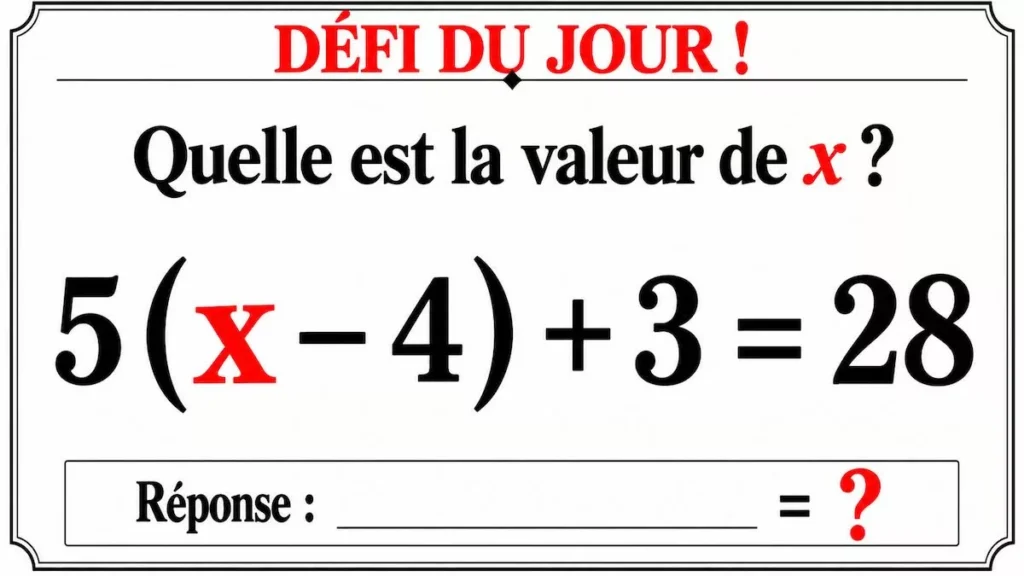
What is the value of x in the following equation?
Observe the equation carefully before you begin: there’s no need to complicate calculations if a direct method is possible.
You have 30 seconds to find x.
The Countdown Begins
20…
15…
10…
5…
4…
3…
2…
1…
Time’s up!
What Your Performance May Reveal
If you found the result quickly and correctly, you have excellent logic and analytical skills.
If you found the result after some thought, you know how to structure your reasoning and check your steps.
And if the result was incorrect or not found, no worries; this type of exercise is perfect for improving method and precision.
Detailed Solution We Found (Not Necessarily the Only One, But Sometimes the Right One)
We start with the equation:
5(x − 4) + 3 = 28
First, let’s subtract 3 from both sides:
5(x − 4) = 25
Next, we divide both sides by 5:
x − 4 = 5
Now, we simply add 4 to both sides:
x = 9
Let’s Verify Our Result
Let’s replace x with 9 in the original equation:
5(9 − 4) + 3 = 28
First, let’s calculate the parentheses:
9 − 4 = 5
So:
5 × 5 + 3 = 28
25 + 3 = 28
The equality is correct.
Answer: x = 9
Conclusion
This challenge shows that an equation containing parentheses does not always require starting by expanding them. Here, it was particularly quick to proceed with inverse operations: subtracting 3, dividing by 5, and then adding 4.
Thus, we arrive at x = 9 in just a few steps, and the verification immediately confirms the result.
If you found 9 before the countdown ended, congratulations! The goal was not only to arrive at the correct answer but also to understand how to gradually isolate the unknown without losing the balance of the equation.
And before you get lost in the depths of the web, explore other games and tests by clicking here.