Several centuries ago, solving an equation often meant narrating a problem in words. Gradually, mathematicians developed a symbolic language capable of representing an unknown by a single letter. This evolution profoundly transformed mathematics: a few symbols now allow us to describe situations encountered in physics, engineering, computer science, economics, and construction.
The significance of equations is not merely to “find x.” They primarily teach us to reason backward, maintain balance between two quantities, and consider all possible solutions.
“It is impossible to be a mathematician without having a poet’s soul.” — Sofia Kovalevskaïa
Often, when faced with an equation involving a square, we immediately think of a single answer. However, the same square can arise from two opposite numbers. This serves as a good reminder. In mathematics, finding one solution does not always mean we have discovered all solutions.
What This Challenge Allows You to Work On:
- solving an equation;
- understanding the concept of a square;
- using the square root;
- considering both positive and negative solutions;
- algebraic reasoning;
- verifying a solution;
- speed and accuracy.
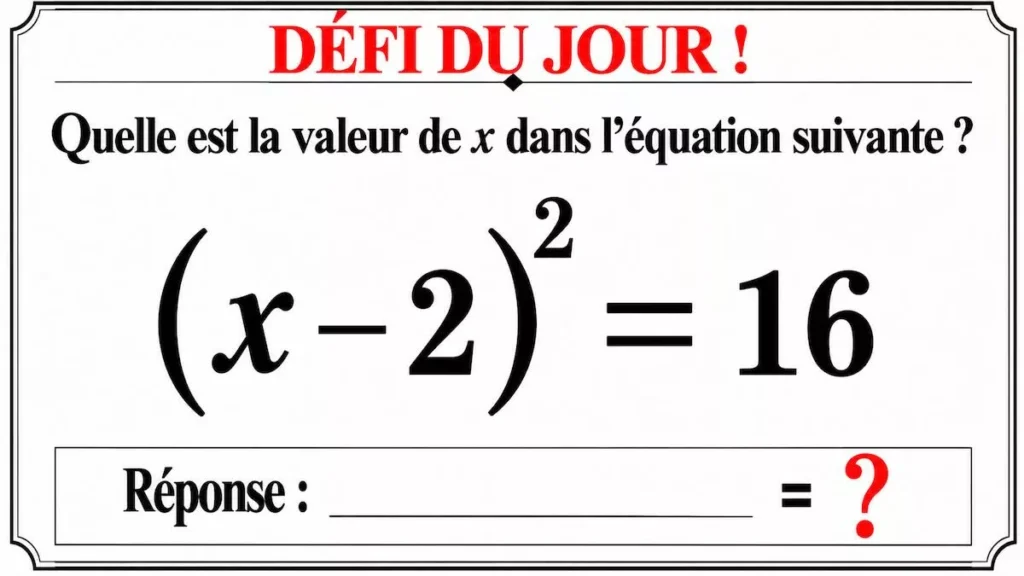
CHALLENGE OF THE DAY!
What is the value of x in the following equation?
Note: there may be more than one solution.
You have 30 seconds.
The Countdown Begins
30…
25…
20…
15…
10…
5…
4…
3…
2…
1…
Time’s up!
What Your Performance May Reveal
If you found the result quickly and correctly, you have excellent logic and analytical skills.
If you found the result after some thought, you know how to structure your reasoning and verify your steps.
And if your result was incorrect or you didn’t find it, no worries; this type of exercise is perfect for improving your method and precision.
Detailed Solution We Found (Not Necessarily the Only One, or Even the Correct One)
We have:
For a number raised to the power of two to equal 16, that number can be 4, but also −4.
Therefore, we must consider two possibilities.
First possibility:
x − 2 = 4
Adding 2:
x = 6
Second possibility:
x − 2 = −4
Adding 2 again:
x = −2
Let’s verify:
(6 − 2)² = 4² = 16
and
(−2 − 2)² = (−4)² = 16
Both values satisfy the equation.
Answer: x = 6 or x = −2
Conclusion
This challenge contains an interesting trap: an equation involving a square can have multiple solutions. Stopping at x = 6 would overlook that −4 squared also gives 16.
This is precisely what equations teach us: not just to seek one answer that works, but to determine the entire set of answers that meet the given condition.
Thus, the complete solution is: x = 6 or x = −2.
And before you get lost in the depths of the web, explore other games and tests by clicking here.