From the early geometric constructions of Antiquity to modern technologies, angles have always played an essential role. Builders used them to raise monuments, astronomers to observe the sky, and navigators to determine their direction. Even today, geometry is involved in architecture, cartography, engineering, computer science, and even in the design of three-dimensional images.
What I particularly enjoy about geometry challenges is that a figure may seem complicated, while its solution often relies on just two or three very simple properties. I have often spent a long time searching for a complex method only to realize that a simple additional angle could unlock the entire reasoning process. This is precisely what makes these exercises interesting: they teach us to look before calculating.
“Geometry is the art of reasoning rightly about wrong figures.” — Henri Poincaré
This quote reminds us of an important point: a geometric drawing serves as a support, but it is the mathematical properties that allow us to demonstrate the answer. Therefore, one must never rely solely on what the eye believes it sees.
What This Challenge Helps To Work On:
- This challenge allows you to work on the sum of the angles in a triangle,
- supplementary angles,
- identifying the correct triangles in a figure,
- step-by-step reasoning, and especially the ability to distinguish between an interior angle and an exterior angle.
It also helps develop observation, concentration, and caution when faced with a figure containing several intersecting lines.
Challenge of the Day
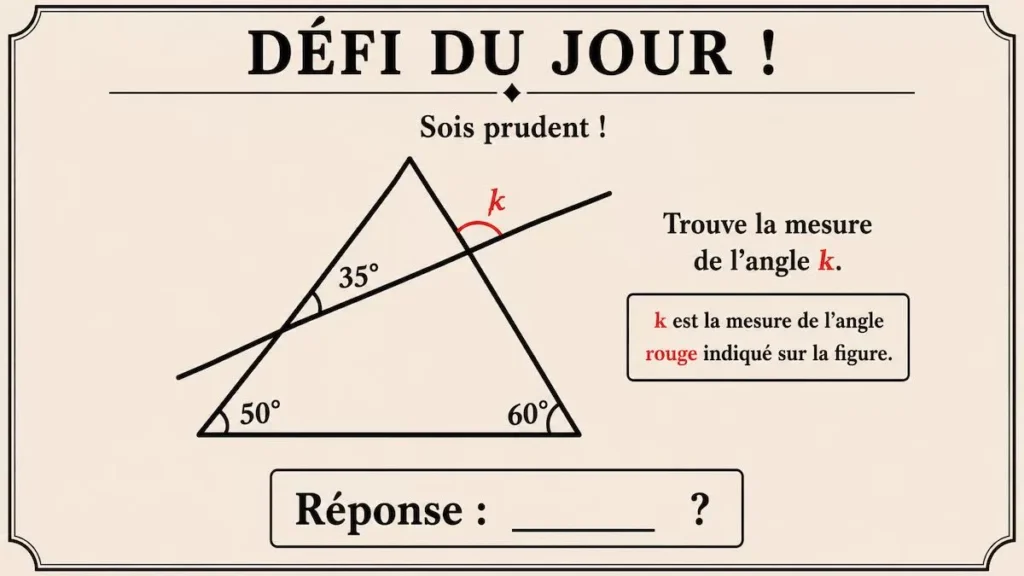
Carefully observe the figure.
Your goal is to determine the measure of the red angle k.
Note: k is an exterior angle. This is precisely where the challenge lies.
What is the measure of angle k?
The Countdown Begins
30…
25…
20…
15…
10…
5…
4…
3…
2…
1…
Time’s up!
What Your Performance Can Reveal
If you found the result quickly and correctly, you have excellent logic and analytical skills.
If you found the result after some reflection, you know how to structure your reasoning and check your steps.
And if your result was incorrect or you couldn’t find it, no worries; this type of exercise is perfect for improving your method and precision.
Detailed Solution We Found (Not Necessarily the Only or Even the Right One)

Let’s start by determining the angle at the top of the large triangle.
The sum of the angles in a triangle equals 180°.
So we have:
50° + 60° + top angle = 180°
The top angle is:
180° − 50° − 60° = 70°
Now let’s look at the small triangle formed in the upper part of the figure.
We know two of its angles:
35° and 70°.
Let’s temporarily call the third angle a.
We can write the equation:
35° + 70° + a = 180°
Thus:
a = 180° − 105°
a = 75°
But be careful: 75° is not angle k.
The angle of 75° and the red angle k are supplementary angles, as they are on either side of the same line.
So we have the equation:
k + 75° = 180°
Therefore:
k = 180° − 75°
k = 105°
Final Answer
k = 105°
Conclusion
This challenge is an excellent example of a geometric trap. Finding 75° is not enough: this value corresponds to the interior angle of the small triangle, while the question asks for the exterior red angle k.
One had to perform a final step and use the property of supplementary angles.
The correct answer is indeed 105°.
This type of challenge reminds us of a valuable rule in geometry: before giving an answer, always check that the angle you’ve just calculated is indeed the one requested in the figure.
And before you get lost in the web’s maze, explore other games and tests by clicking here.