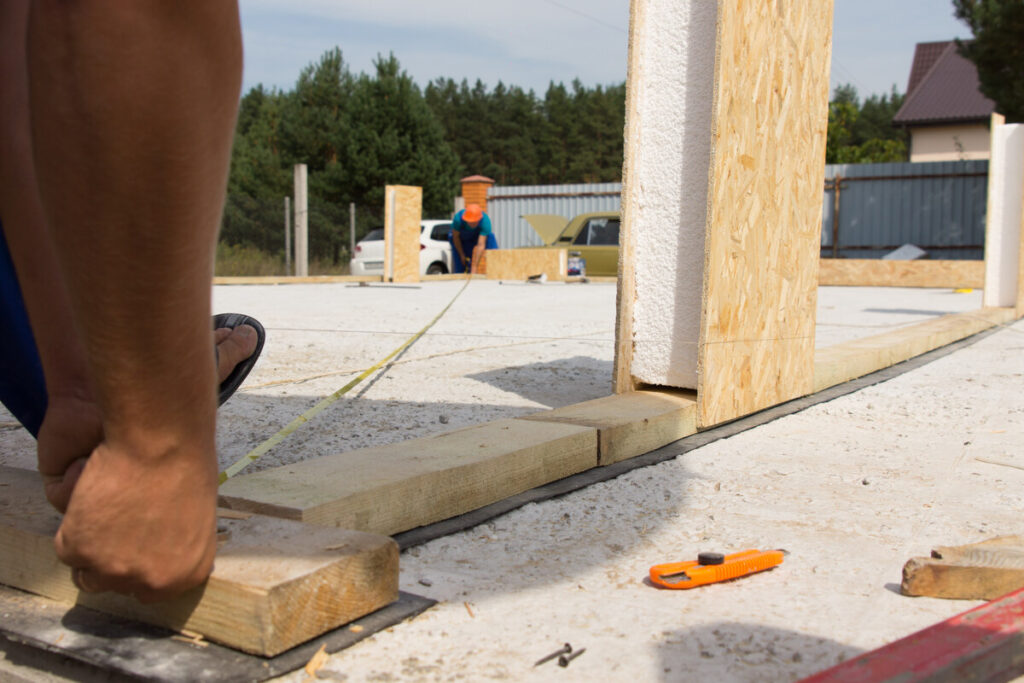
Marking out a slab, a fence line or a room and need a corner that is truly square? You only need a tape measure and three numbers: 3, 4 and 5. If one side is 3 units, the other is 4 units and the diagonal between their ends is exactly 5 units, the corner is a perfect right angle.
Why the 3-4-5 rule works
The rule comes straight from the Pythagorean theorem: in a right triangle, the two short sides squared and added together equal the long side (the hypotenuse) squared. Here that is 3 × 3 + 4 × 4 = 9 + 16 = 25, and 5 × 5 = 25. It balances perfectly, so the angle between the 3 and the 4 has to be 90°.
The reverse also holds, and that is the part builders rely on. Euclid wrote it down in his Elements (Book I, Proposition 48): “If in a triangle the square on one of the sides equals the sum of the squares on the remaining two sides of the triangle, then the angle contained by the remaining two sides of the triangle is right.” In plain words: if your three measurements fit the formula, the corner is square. No protractor needed.
How to do it on site, step by step
- Fix the corner point, then measure 3 units along one line and mark it.
- Measure 4 units along the other line from the same corner and mark it.
- Measure the diagonal between the two marks. It must read exactly 5 units.
- If it reads more, the angle is wider than 90°. If it reads less, the angle is narrower. Shift one line slightly and measure again until it reads 5.
A “unit” can be anything, as long as you use the same one for all three sides. It can be feet, metres or even the length of a ruler.
Make it bigger for better accuracy
Any multiple of 3-4-5 is also a right triangle. So 6-8-10 works, and so does 9-12-15 (9 × 9 + 12 × 12 = 81 + 144 = 225 = 15 × 15). For a slab or a boundary wall, use a larger version such as 3 m, 4 m and 5 m, or 6 m, 8 m and 10 m. A small slip of the tape matters much less over a long distance, so the bigger triangle gives you a more reliable corner.
A worked example: how much is a small error worth?
Say you mark 3 m and 4 m from a corner, and the diagonal reads 5.10 m instead of 5.00 m. That looks like a tiny 10 cm slip, but it means the corner is about 92.4° instead of 90°. Over the 4 m side, the end of the line is roughly 17 cm out of place. If the diagonal reads 4.90 m, the corner is about 87.6° and the end is roughly 17 cm off in the other direction.
These figures come from the law of cosines. The practical point is that a diagonal that is off by 2% means a wall that ends up almost 17 cm crooked over 4 m.
Other triangles that work the same way
3-4-5 is not the only whole-number right triangle. With Euclid’s formula (sides m² − n², 2 × m × n and m² + n², for whole numbers m larger than n), m = 3 and n = 2 give 5-12-13, since 25 + 144 = 169 = 13 × 13. Handy for long runs.
Common mistakes to avoid
- Mixing units. 3 feet, 4 metres and 5 feet will never give a right angle. Use one unit throughout.
- Letting the tape sag. A sagging tape reads longer than the true distance, so keep it tight and level.
- Measuring from the wrong point. All three measurements must start from the exact corner point, not from the edge of a stake.
- Trusting a tiny triangle. A 30 cm, 40 cm, 50 cm triangle hides errors that a 3 m, 4 m, 5 m triangle would reveal.
A short note on history
You will often read that ancient Egyptians laid out right angles with a knotted 3-4-5 rope. Wikipedia calls this much debated: no Egyptian text before 300 BC mentions using the theorem for that purpose. The rule itself is still used by modern surveyors.
Check any triangle yourself
Want to test other side lengths or find the area of a triangular plot once the corner is set? Try our triangle calculator, and see our guide to measuring a triangular plot with Heron’s formula.