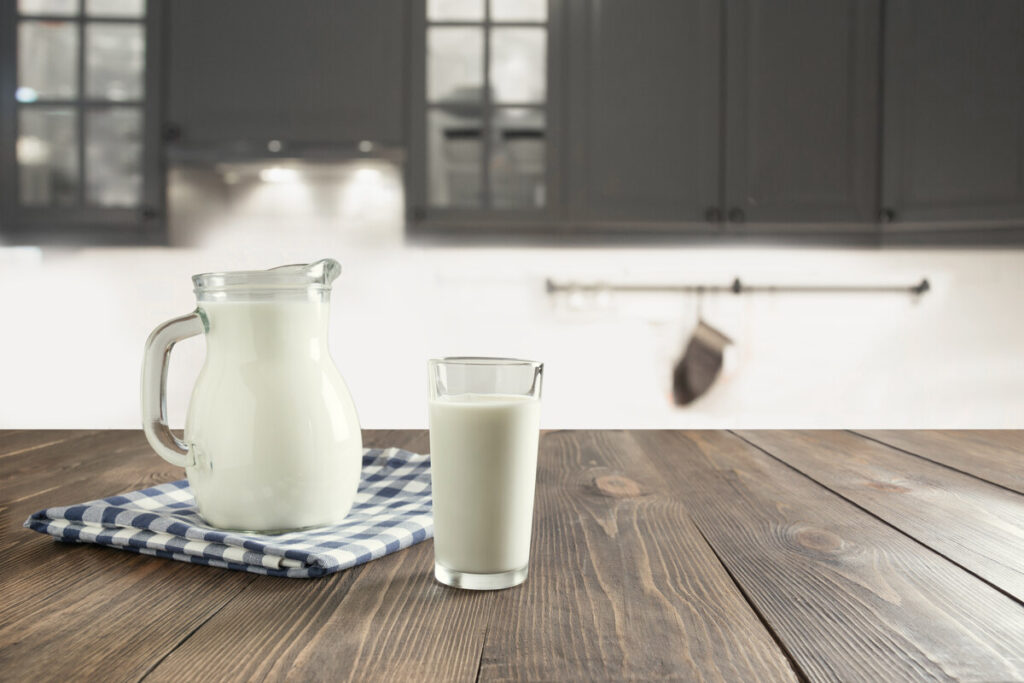
A glass of milk is often sold as “your daily calcium”, but the numbers say otherwise. Here is how much calcium one glass really gives you, and how to read the percentage on a food label.
What one glass of milk actually contains
According to Wikipedia, one cup (250 mL) of 2% fat cow’s milk contains 285 mg of calcium. That is a good amount, but it is only a slice of what adults are advised to eat in a day, roughly 22% to 29% of the daily recommended intake.
The target is not the same everywhere
There is no single worldwide number. The European Food Safety Authority sets a Population Reference Intake of 1,000 mg a day for ages 18 to 24 and 950 mg a day for adults aged 25 and over. On US food labels, 100% of the Daily Value was 1,000 mg until 27 May 2016, when it was raised to 1,300 mg.
So the same glass of milk looks different depending on which yardstick a label or a website uses.
The simple math: milk share of your day
Divide the calcium in the glass by your daily target, then multiply by 100.
- Against 950 mg: 285 ÷ 950 = 30%
- Against 1,000 mg: 285 ÷ 1,000 = 28.5%
- Against 1,300 mg: 285 ÷ 1,300 = 21.9%
To see how many glasses it would take on milk alone, divide the target by 285. That is about 3.3 glasses for 950 mg, 3.5 glasses for 1,000 mg and 4.6 glasses for 1,300 mg. In other words, one glass is closer to a quarter of the job than the whole of it, and the rest has to come from the other foods you eat across the day.
How to read %DV on a label
On a US-style label, the %DV figure is measured against the Daily Value, now 1,300 mg for calcium. To turn a percentage back into milligrams, multiply it by 1,300. For example, a product showing 15% DV gives about 195 mg of calcium per serving (0.15 × 1,300), and one showing 20% DV gives about 260 mg. This is a simple label example for practice, not a particular product.
Common mistakes
- Treating one glass as the full daily need. It covers roughly a quarter to a third, depending on your target.
- Mixing up targets. A 950 mg figure from Europe and a 1,300 mg Daily Value from a US label are not interchangeable.
- Chasing more is not always better. The US Institute of Medicine sets an upper limit of 2,500 mg a day from food and supplements combined for ages 19 to 50, and 2,000 mg a day from age 51. Very high intakes are linked to calcification of arteries and kidney stones.
The bottom line
Pick the target that applies to you, divide, and count your whole day, not just the glass. If you also want to check other numbers on your plate, our guides on daily protein and daily fibre use the same divide-and-compare approach.