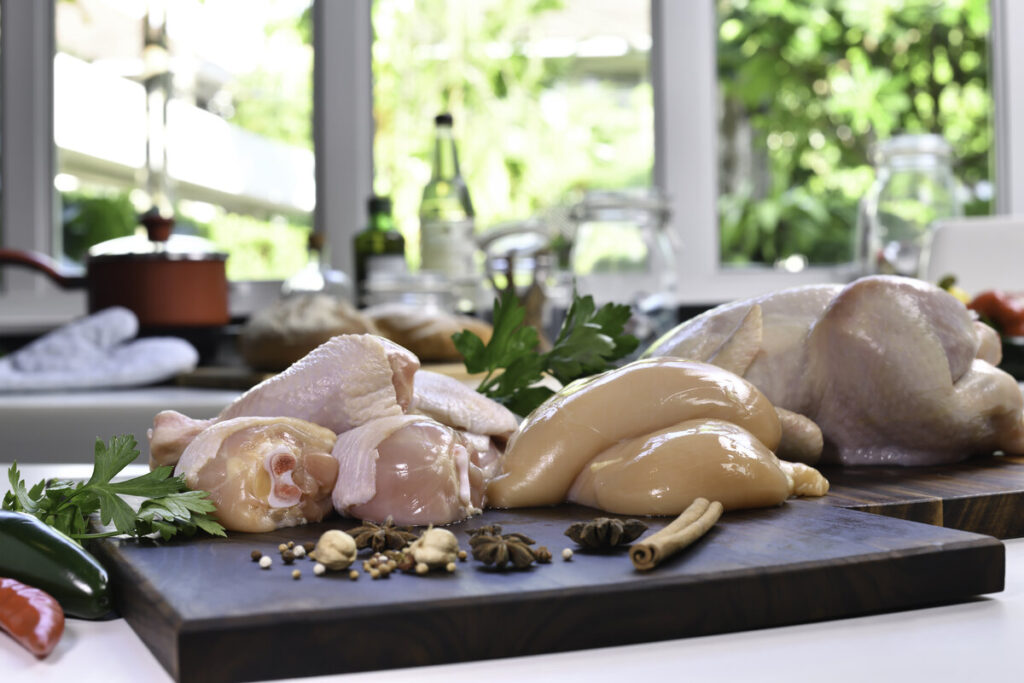
Following an American recipe that asks for 2 pounds of chicken or a 9-inch cake tin? Many home cooks simply treat a pound as half a kilo and an inch as “about 2.5 cm”. Those shortcuts feel harmless, but they quietly change your quantities. Here is the exact conversion math, and how to apply it in seconds.
Why a pound is not half a kilo
A unit of measurement is simply a quantity fixed by convention or by law, used as a reference to measure other quantities of the same kind. The problem in the kitchen is that two systems still live side by side. Most of the world uses the metric system, created in France in 1791, and its modern form, the International System of Units (SI), adopted in 1954. The United States, on the other hand, remains a “dual-system” society that uses both SI and its own US customary units every day, which is why so many online recipes mix cups, pounds and inches.
The good news is that the old units are no longer vague. Since an international agreement in 1959, they are defined exactly in metric terms:
- 1 pound (avoirdupois) = exactly 0.45359237 kg, so about 453.6 g, not 500 g
- 1 inch = exactly 0.0254 m, so exactly 2.54 cm
In other words, half a kilo is about 10% heavier than a real pound. On a small amount that barely matters. On a large batch or a baking recipe, it can be the difference between a moist cake and a dry one.
The one formula you need
Every unit conversion works the same way: target value = source value × conversion factor. The conversion factor is just the fixed ratio between the two units. To go from pounds to kilograms, multiply by 0.45359237. To go from inches to metres, multiply by 0.0254 (or by 2.54 if you want centimetres).
To go the other way, divide instead of multiplying. For example, 1 kg divided by 0.45359237 gives about 2.2 pounds.
A real example from the kitchen
Say your recipe calls for 2 pounds of chicken:
- Exact conversion: 2 × 0.45359237 = 0.907 kg, so roughly 907 g
- “Half a kilo per pound” shortcut: 2 × 500 g = 1,000 g
The shortcut adds about 93 g of meat. That might be fine for a curry, but the same error applied to butter, flour or sugar changes the balance of a bake, because the ratio between ingredients shifts as soon as some are rounded up and others are measured exactly.
Now the cake tin. A 9-inch round tin is 9 × 2.54 = 22.86 cm, so a 23 cm tin is the right match, not a 25 cm one. An 8-inch tin works out to 20.32 cm, which means a standard 20 cm tin. Smaller measurements follow the same rule: 5 inches is 5 × 0.0254 = 0.127 m, or 12.7 cm.
Why metric conversions feel so much easier
Inside the metric system, changing scale always means multiplying or dividing by a power of 10: 1,000 g = 1 kg, 100 cm = 1 m. Imperial and US units use irregular steps instead: 12 inches make a foot and 3 feet make a yard. That is why the safest habit is to convert everything to metric once, at the start, and then work only in grams and centimetres.
Common mistakes to avoid
- Assuming same name means same size. British imperial units and US customary units often share a name (pint, gallon, ounce) but correspond to different volumes. Check which country a recipe comes from before converting.
- Trusting every “metric” cup. Some local variants, like the 250 mL metric cup, differ from other standards, so a cup is not a universal amount.
- Underestimating unit errors. Mixing up units has caused real disasters: NASA lost its Mars Climate Orbiter probe in 1999 after a newton and pound-force mix-up, and the “Gimli Glider” airliner ran out of fuel in 1983 because of a litres and gallons confusion during refuelling. Your cake is lower stakes, but the lesson is the same.
The takeaway is simple: keep the two exact factors in mind (0.4536 for pounds, 2.54 for inches), multiply once, and round only at the very end.