Mathematics has a fascinating history: for centuries, humans have sought ways to represent what they did not yet know. Even before the modern use of the letter x, mathematicians were already solving problems where an unknown quantity had to be discovered. Algebra later provided a universal language for this way of reasoning. This advancement has had immense consequences. Equations are now used to calculate trajectories, construct buildings, design machines, develop software, predict certain physical phenomena, and even send probes into space. Thus, a simple school equation is based on an idea that has contributed to some of humanity’s greatest scientific and technological achievements.
I remember an exercise where a very short equation took me a long time to solve because I wanted to immediately expand the parentheses. Then someone showed me that there was a much quicker method: start by canceling the outer operation before touching the inside of the parentheses. Since then, when faced with an equation, I first look for the path that requires the least calculation.
Quote of the Day
“Life is only good for two things: discovering mathematics and teaching mathematics.” — Siméon Denis Poisson
This quote perfectly captures the passion that mathematics can inspire: behind a simple equation often lies a little logical mechanism that is particularly satisfying to uncover.
What This Challenge Allows You to Work On:
- Solving an equation;
- Understanding parentheses;
- Inverse operations;
- Division;
- Subtraction;
- Manipulating negative numbers;
- Mental calculation;
- Logic;
- Concentration;
- Verifying a solution.
Challenge of the Day
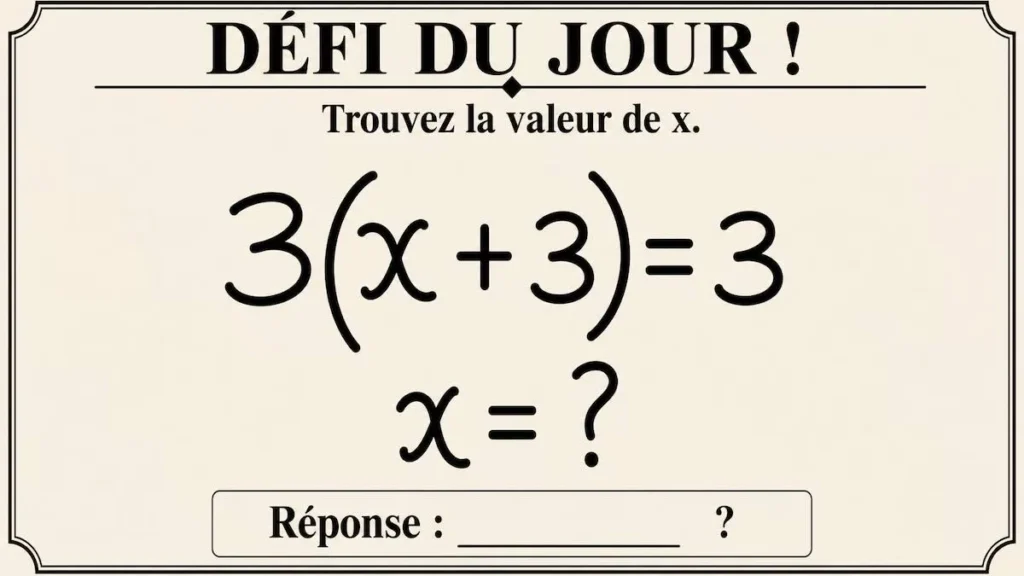
Here is the equation:
Your mission is to find the value of x.
The equation may seem very simple, but beware: the answer is not necessarily positive.
Try to solve it mentally before the countdown ends.
The Countdown Begins
30…
25…
20…
15…
10…
5…
4…
3…
2…
1…
Time’s up!
What Your Performance Can Reveal
If you found the result quickly and correctly, you have excellent logic and analytical skills.
If you found the result after some thought, you know how to structure your reasoning and verify your steps.
And if your result was incorrect or not found, no worries; this type of exercise is perfect for improving method and precision.
Detailed Solution We Found (Not Necessarily the Only One, Sometimes Even the Correct One)
We start from the equation:
3(x + 3) = 3
Our goal is to isolate x.
One possibility would be to expand the parentheses. But here, there is an even quicker method.
Since the entire content of the parentheses is multiplied by 3, let’s divide both sides of the equation by 3.
We obtain:
x + 3 = 1
Now, to isolate x, we subtract 3 from both sides:
x = 1 − 3
So:
x = −2
Let’s Verify the Answer
Let’s replace x with −2 in the initial equation:
3(−2 + 3) = 3
First, let’s calculate the inside of the parentheses:
−2 + 3 = 1
Therefore:
3 × 1 = 3
The equality is perfectly verified.
Answer: x = −2
Conclusion
This challenge shows that an equation does not need to be lengthy to test our reasoning. Here, the real challenge was to quickly recognize the inverse operations: starting by removing the multiplication by 3, then subtracting 3 to isolate the unknown. It also reminds us of an important point: an unknown can perfectly have a negative value.
Therefore, never dismiss an answer simply because it is below zero. If you found x = −2 before the countdown ended, you chose a quick and efficient method. Even if it took you longer, the key is to be able to explain each step and verify the result.
And before you get lost in the depths of the web, explore other games and tests by clicking here.