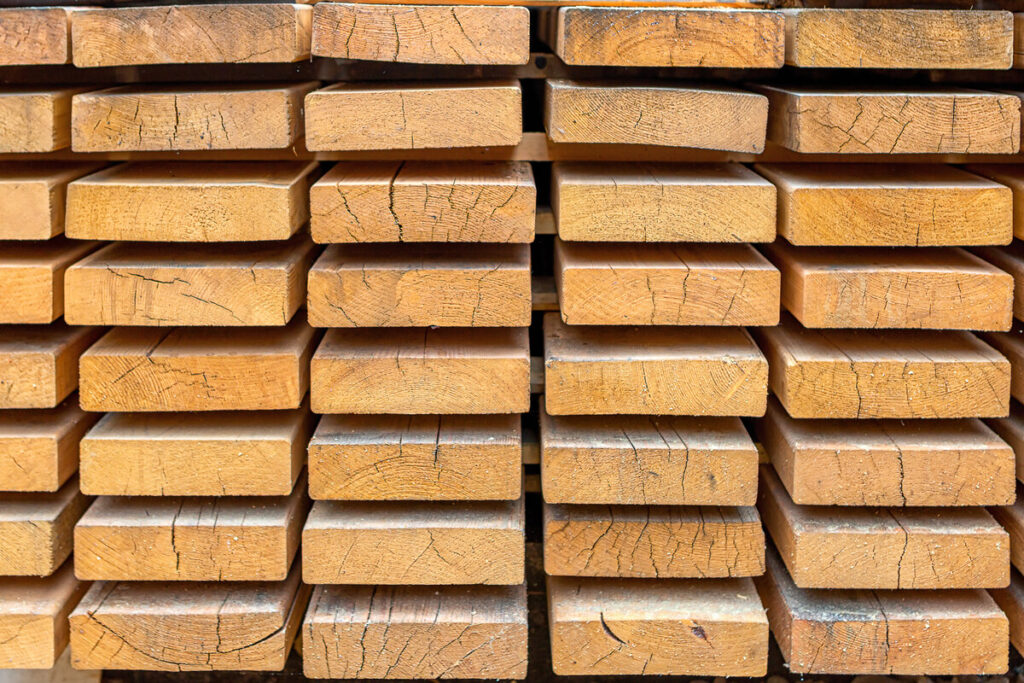
A 2×4 is not 2 inches by 4 inches. In the US and Canada, the finished board you carry out of the yard measures 1½ × 3½ inches, and forgetting that is one of the easiest ways to get a frame, shelf or fence wrong.
Why the label does not match the board
The name on the stack is the nominal size. Historically, a “2×4” really was a rough, green board about 2 by 4 inches. Once it was dried and planed smooth, it shrank by a non-standard amount. Today the standard fixes the finished size instead, and a 2×4 is a minimum of 1½ × 3½ inches (38 × 89 mm).
The only exception is green, unfinished lumber, where the nominal size and the actual size are the same.
Common sizes: nominal vs actual
- 1×2 is actually ¾ × 1½ in (19 × 38 mm)
- 1×4 is actually ¾ × 3½ in (19 × 89 mm)
- 2×2 is actually 1½ × 1½ in (38 × 38 mm)
- 2×3 is actually 1½ × 2½ in (38 × 64 mm)
- 2×4 is actually 1½ × 3½ in (38 × 89 mm)
- 4×4 is actually 3½ × 3½ in (89 × 89 mm)
The pattern: a 1-inch nominal board is ¾ inch thick, a 2-inch nominal board is 1½ inches thick, and the width is usually half an inch under the label for the narrow sizes.
The simple rule for planning
Never plan with the label. Plan with the actual size, then add up the actual sizes. It is the same idea as nominal versus actual brick size: the number on the label includes allowances the real piece does not have.
Worked example: three 2×4s side by side
Say you lay three 2×4 boards flat, edge to edge, to make a bench top.
- Using the label: 3 × 2 = 6 inches wide
- Using the real size: 3 × 1½ = 4½ inches wide
That is a 1½ inch gap in your plan. With seven boards the gap grows to 3½ inches (10½ inches instead of 14). The same error hits depth: a 2×4 wall is a 3½ inch deep frame, not a 4 inch one.
How much smaller is the real board?
A 2×4 labelled as 2 × 4 inches would have a cross-section of 8 square inches. The real 1½ × 3½ board has 5.25 square inches, which is about 66% of the area the label suggests (my own calculation). A 4×4 works out the same way: 12.25 square inches against 16, about 77%.
The boards also got slimmer over time. A finished 1-inch board was 13/16 inch in 1910 and was fixed at ¾ inch in 1961, when the 2-inch nominal thickness dropped from 1⅝ to the current 1½ inches. In a 1964 test reported by Popular Mechanics, the compressive strength of today’s 1½ × 3½ size came out at 73.6% of a full 2 × 4 inch board.
Common mistakes
- Measuring a gap and ordering by the label. A 3½ inch cavity takes a 2×4 on its wide face, not a “4 inch” board.
- Adding nominal widths. Always add the actual widths.
- Assuming the length is also short. Length is specified separately: standard US and Canadian lengths run from 6 to 24 feet, so a board labelled 8 feet is sold as 8 feet. Precut studs for an 8 foot ceiling are 92⅝ inches, to leave room for the plates.
- Assuming this is global. These sizes are the North American softwood standard. If you buy in India, check the dimensions the seller actually quotes, because the source does not cover local sizes.
Related reading: the actual stair math uses the same habit of measuring the real piece, and the concrete slab guide shows how a small error in thickness changes the whole quantity.