There have been moments when mathematics truly changed the course of history. The invention of zero, the development of algebra, the geometry that allows us to map the world, and the calculations that made space travel possible have transformed our understanding and construction of the world. What seems like a simple calculation today is actually built upon centuries of discoveries and one essential idea: A common rule allows everyone to arrive at the same result.
Mathematics is much more than a sequence of numbers. It serves to predict, measure, construct, program, and solve problems. From bridges to satellites, computers to modern medicine, many great achievements rely on the ability to organize reasoning correctly.
“Mathematics is the alphabet with which God has written the universe.” — Galileo
I remember an exercise that was quite similar to this one. The numbers were straightforward, and I immediately wanted to start with division. However, one detail changed everything: there were parentheses. This kind of challenge reminds us that in mathematics, a few seconds of observation can prevent an entire calculation error.
What This Challenge Helps to Work On:
- the priority of parentheses;
- multiplication and division;
- the order of operations;
- mental calculation;
- attention to detail;
- speed of reasoning;
- verifying an equation.
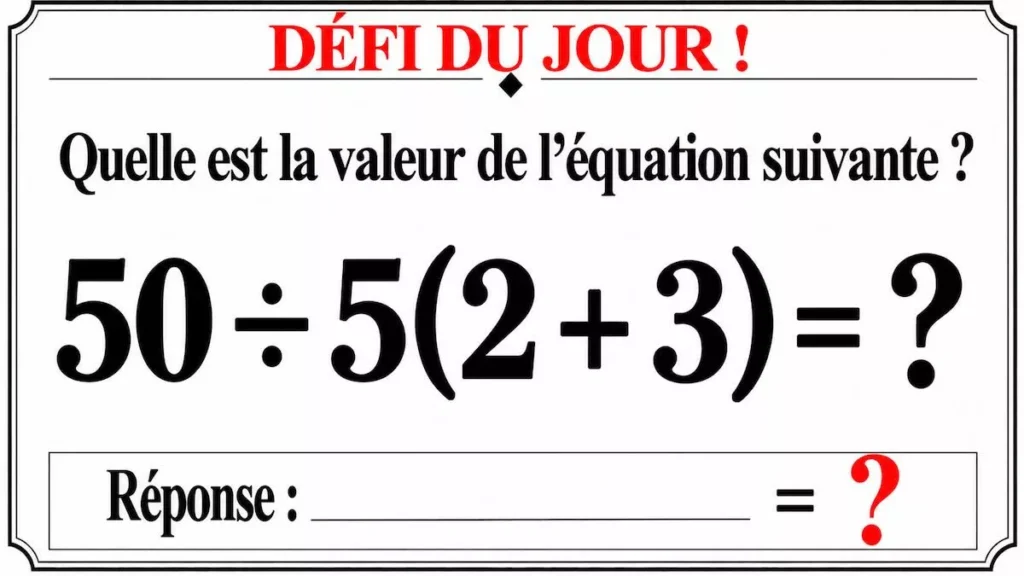
DAILY CHALLENGE!
What is the value of the following equation?
Be careful: don’t rush. Start by determining which part of the equation should be calculated first.
The Countdown Begins
30…
25…
20…
15…
10…
5…
4…
3…
2…
1…
Time’s up!
What Your Performance Can Reveal
If you found the result quickly and correctly, you have excellent logic and analytical skills.
If you found the result after some reflection, you know how to structure your reasoning and verify your steps.
And if your result was incorrect or not found, no worries, this type of exercise is perfect for improving method and precision.
Detailed Solution We Found (Not Necessarily the Only One, or Even the Correct One)
We start with the parentheses:
2 + 3 = 5
The equation then becomes:
50 ÷ 5 × 5
Multiplication and division have the same priority. Without any other grouping indicated, we perform them from left to right.
First:
50 ÷ 5 = 10
Then:
10 × 5 = 50
Answer: 50
Conclusion
This challenge perfectly illustrates why mathematical conventions are important. After calculating the parentheses, it is crucial not to automatically prioritize multiplication over division: multiplication and division are at the same level of priority and are treated from left to right.
Thus, with the expression presented:
50 ÷ 5(2 + 3) = 50
This is also a good example of the ambiguities that linear notation can create. To avoid any confusion, an equation should ideally clarify the desired grouping with a fraction bar or additional parentheses.
And perhaps the best lesson from this challenge is: in mathematics, finding the right result matters, but writing an equation without ambiguity matters just as much.
And before you get lost in the depths of the web, explore other games and tests by clicking here.