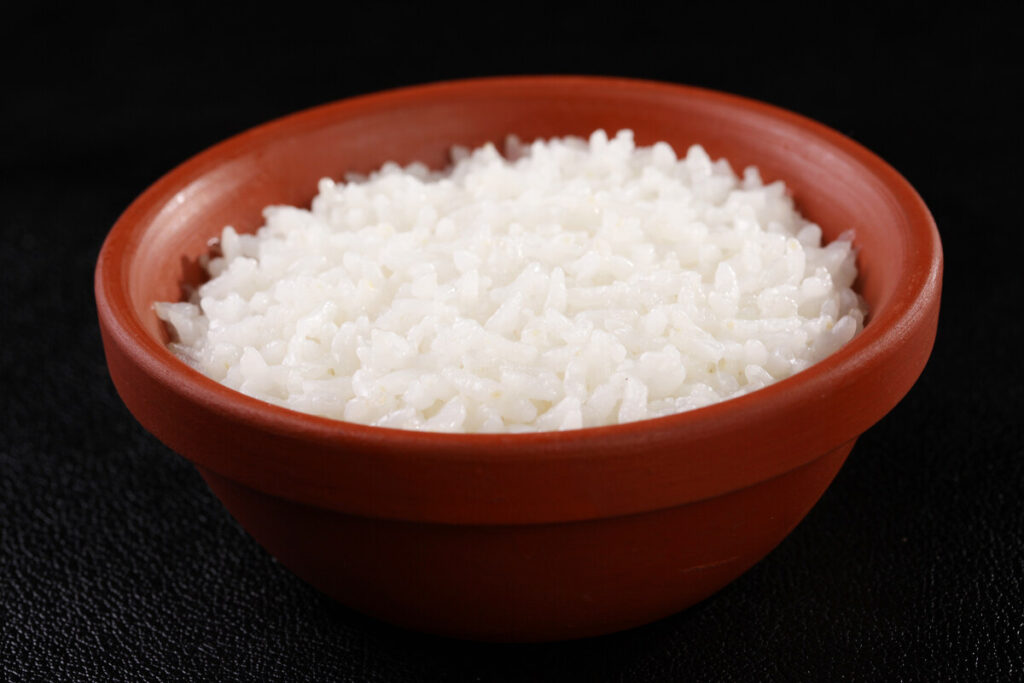
You scoop a plate of cooked rice and wonder what it adds up to. The answer takes one multiplication, as long as you use the right number for the right kind of rice.
Why a plate of rice weighs so much more than its grains
Cooked white rice is about 69% water, 29% carbohydrates and 2% protein, with negligible fat. Water has no calories, so most of the weight on your plate is energy-free. That is why the figure you need is calories per 100 g of cooked rice, not of the dry grain in the packet.
The formula: grams of cooked rice x 1.3
A 100 g reference serving of cooked white rice provides about 130 calories. That works out to 1.3 calories per gram, so the method is simple:
- Weigh the cooked rice on your plate, in grams.
- Multiply by 1.3.
- The result is the calories (kcal) in that serving.
If you want the figure to make sense, you can cross-check it. Carbohydrates and protein give roughly 4 calories per gram each (the same rule explained in our guide to the calorie count on a food label). So 100 g of cooked rice gives 29 x 4 + 2 x 4 = 124 calories, close to the 130 on the reference table once rounding is allowed for.
A worked example: three plate sizes
Here is what the formula gives for three common amounts of cooked white rice:
- 150 g (a small bowl): 150 x 1.3 = 195 calories, 43.5 g carbohydrates, 3 g protein
- 200 g (a standard plate): 200 x 1.3 = 260 calories, 58 g carbohydrates, 4 g protein
- 250 g (a generous plate): 250 x 1.3 = 325 calories, 72.5 g carbohydrates, 5 g protein
In the 200 g plate, 138 g is simply water. Only about 62 g is actual rice solids, which is where all 260 calories come from.
The mistake that skews your count
The most common slip is mixing raw and cooked weights. Of every 100 g of cooked rice, only about 31 g is non-water material, and that 31 g carries the 130 calories. That is roughly 4.2 calories per gram of solids, around three times the density of cooked rice (1.3 calories per gram).
Dry grain contains very little water, so 100 g of uncooked rice holds far more energy than 100 g of cooked rice. Use the cooked figure with a cooked weight, and the dry figure with a dry weight, never the other way round. Weigh before cooking and apply the cooked number, and you will undercount. Weigh after cooking and apply the dry number, and you will overcount by a wide margin. Check whether your packet or app says “cooked” or “uncooked” before you trust it.
Does the type of rice change the number?
The 130 calories per 100 g applies to cooked white rice. Brown rice has only the inedible husk removed, while white rice also loses the bran and germ. Parboiled rice is steamed before milling, which moves some vitamins and minerals into the white part of the grain. Long-grain varieties such as basmati stay dry and fluffy, and short-grain types turn sticky, but those texture differences do not change the method. For brown, parboiled or flavoured rice, read the label on your own pack and use that cooked figure in the same multiplication.
Quick recap
- Cooked white rice is about 69% water and gives roughly 130 calories per 100 g.
- Calories = grams of cooked rice x 1.3.
- A 200 g plate is about 260 calories and 58 g of carbohydrates.
- Never pair a raw weight with a cooked figure, or the reverse.
Rice is a staple for more than half of the world’s population, and it provides protein but not all the essential amino acids. If you want to see how much protein you need over a whole day, our protein by body weight guide covers it.