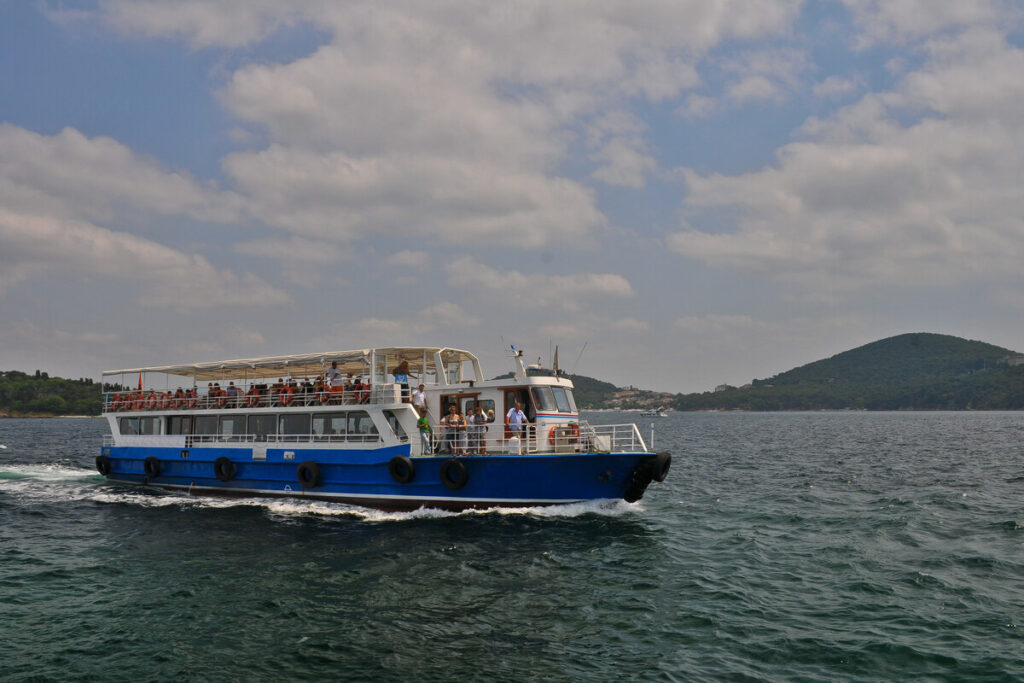
Ferry timetables, cruise brochures and flight trackers all quote speed in knots, and none of them tell you what that means in km/h. Here is the one number you need, and how to use it to work out how long a crossing really takes.
What a knot actually is
A knot is simply one nautical mile per hour. The international nautical mile is defined as exactly 1,852 metres, which is about 6,076 feet or 1.151 statute miles. That makes one knot exactly 1.852 km/h, or roughly 1.151 mph.
The nautical mile is not an arbitrary length. It was originally tied to the Earth itself: one minute (1/60 of a degree) of latitude. Multiply 60 minutes by 360 degrees and you get 21,600 nautical miles, which is very close to the Earth’s polar circumference. That is why sailors and pilots still use it: distance on a chart lines up neatly with latitude.
The simple formulas
- km/h = knots × 1.852
- knots = km/h ÷ 1.852
- km = nautical miles × 1.852
- mph = knots × 1.15078
- travel time in hours = distance in nautical miles ÷ speed in knots
For a quick mental estimate, double the knots and take off about 7%. It is not exact, but it gets you close enough to compare two ferries while you are standing at the ticket counter.
A worked example you can reuse
These figures are illustrative, so swap in the numbers from your own ticket. Say a ferry cruises at 20 knots and the route between two islands is 100 nautical miles.
- Speed in km/h: 20 × 1.852 = 37.04 km/h (about 23 mph)
- Distance in km: 100 × 1.852 = 185.2 km
- Time: 100 ÷ 20 = 5 hours
Going the other way works too. If a road sign or a map tells you the speed is 40 km/h, divide by 1.852 and you get about 21.6 knots.
The same maths works in the air
Pilots use knots as well. An aircraft cruising at 450 knots is moving at 450 × 1.852 = 833.4 km/h. The same formula applies to wind speeds in a weather report, since meteorology also uses knots.
Three mistakes that trip people up
1. Mixing up nautical and statute miles. A nautical mile is 1,852 m, a statute mile is about 1,609 m. Treating them as the same is a real error: 100 nautical miles is about 15% farther than 100 statute miles.
2. Saying “knots per hour”. A knot already contains the “per hour”. Writing “knots per hour” would mean nautical miles per hour per hour, which is an acceleration, not a speed.
3. Comparing indicated and true speed. In aviation, the speed shown on the cockpit instrument is not always the speed through the air. At 11,000 m (36,000 ft), an indicated speed of 300 knots can correspond to a true speed of about 500 knots. A flight tracker quoting ground speed is yet another figure, since wind adds to or subtracts from it.
A practical way to use this on your next trip
Before you book, write down the route length in nautical miles and the vessel’s cruising speed in knots, divide one by the other, then add some buffer for boarding and docking. If you want to compare with a road journey, convert to km/h first so both options are in the same unit.
One last fun fact: a vessel travelling at 1 knot along a meridian covers about one minute of latitude in an hour. That is the whole idea of the unit in a single sentence.